

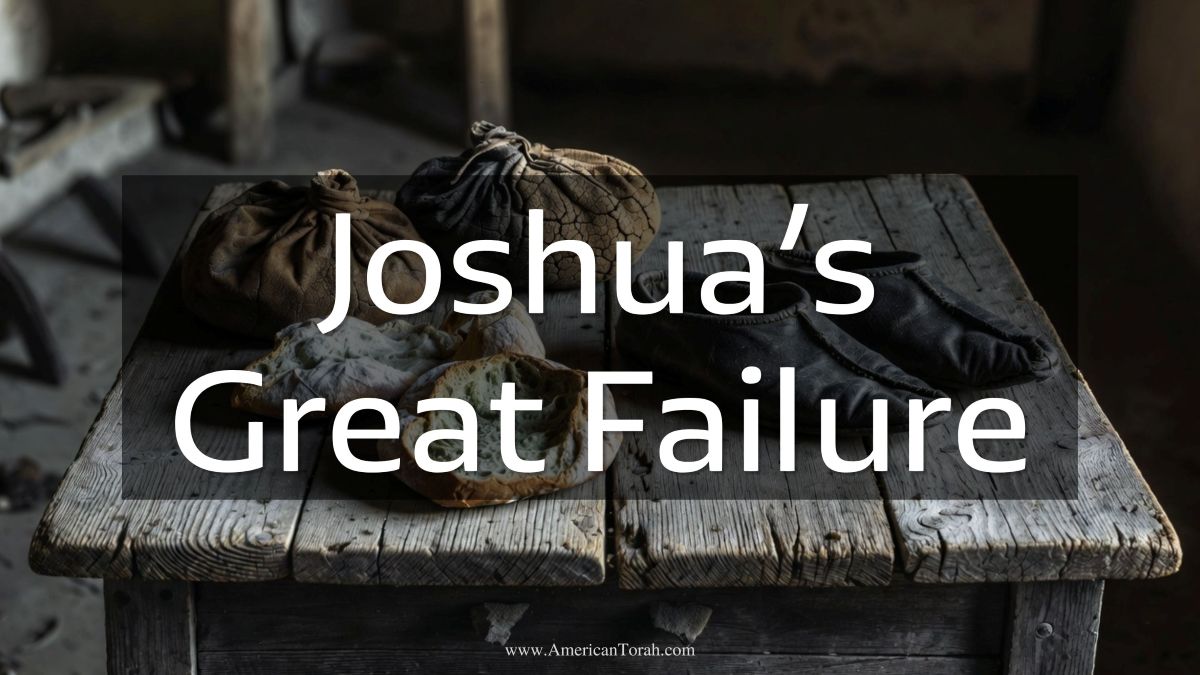
There’s a story in the book of Joshua that I think people often read past without really understanding its importance. The Israelites had just crossed the Jordan, demolished Jericho, taken the city of Ai, and the surrounding Canaanite kings were scrambling in terror. The word had spread that this people and their God were not to be trifled with. Some of the local kings began forming military alliances to fight back, but one group recognized that military confrontation against YHWH was never going to work, so they made a craftier plan that took advantage of this new God’s own character. The Gibeonites sent a delegation to Joshua dressed in worn-out sandals and ragged clothes, carrying patched wineskins and dry, crumbly bread, as if they had been on the road for months. They claimed to have come from a distant country where they heard about the great power and name of Israel’s God, and they wanted to make a covenant of peace with Israel.
It worked. Joshua and the leaders of Israel looked at the moldy bread and the cracked sandals and accepted the evidence at face value. They made a formal covenant of peace with the Gibeonites and only three days later discovered that they were actually neighbors and not some distant nation. They were Canaanites, part of the very people Israel had been commanded not to make agreements with (Exodus 23:32-33).
Joshua 9:14 explains how this happened: “The men of Israel sampled their provisions but did not inquire of YHWH”.
They heard the appeal, tasted the stale bread, looked at the worn sandals, but they did not ask God for discernment of what might lie beneath the surface.
What Is a Covenant, and Why Does It Matter?
Before we get too far into the application, it’s worth understanding what a covenant actually is. We’ve largely lost the concept in modern Western culture. A covenant isn’t simply a contract, at least not the way we usually think of that word. It isn’t a handshake deal or a signed agreement you can terminate under the right conditions and with the right legal team.
A covenant is a formal, binding declaration of relationship sealed by blood. In the ancient world, when two parties entered a covenant, animals were slaughtered and divided. Often (not always) the parties walking between the pieces as if to say, “May what happened to these animals happen to me if I break this agreement”. The covenant created a bond deeper than preference, deeper than convenience. There is no way to end a blood covenant short of death.
When a covenant is made with a people–a tribe, a nation, a family line–even the death of the original parties doesn’t end it, because the covenant is inherited by their descendants. The commitment passes down through the generations. The only exit is death, and for a covenant involving a collective, that means the death of the last surviving member of that line.
This is exactly why, centuries after Joshua’s day, when King Saul slaughtered Gibeonites in violation of that original covenant, God allowed a famine to fall on Israel. When David asked God what brought this calamity, God pointed to Joshua’s covenant broken by Saul (2 Samuel 21). The covenant Joshua made with the Gibeonites on the basis of stale bread was still binding generations later, and the king’s decision to ignore it brought judgment on the whole nation.
Paul affirms this principle in the New Testament: “Even a man-made covenant, once ratified, cannot be set aside or added to” (Galatians 3:15). We see how serious God treated breaking a covenant made with the Gibeonites. How much more serious is a covenant made with God?
The Broader Principle: Extraordinary Bonds Demand Extraordinary Evidence
Most of us aren’t entering formal blood covenants with anyone, let alone neighboring city-states, but the principle illustrated in this story applies far beyond its original context. First impressions are not inherently deceitful–the Gibeonites went to extraordinary lengths to deceive Israel–but they are never sufficient grounds for binding yourself to someone in a high-stakes, long-term relationship.
The degree of scrutiny you apply to any relationship should be proportional to the impact that relationship will have on your life and the lives of those who depend on you.
Marriage is the most obvious and relevant case to most of us today. It is made in the pattern of a covenant: intended to be life-long, sealed by vows before God and witnesses, and inherited by the children born from the union. The family your children grow up in, the culture they’re formed by, the faith they’re raised in–all of this flows downstream from who you choose to marry. No amount of chemistry or shared interests substitutes for time, observation, and wisdom. Proverbs 6:1-5 gives sharp counsel to anyone who has made a hasty pledge: “If you have put up security for your neighbor… do this, my son, to free yourself… go, press your plea with your neighbor!” Even in ordinary financial matters, hasty commitments are worth escaping quickly if possible. How much more in marriage?
Business and real estate deals aren’t covenants–unless you’re sacrificing animals to seal the agreement, in which case you have bigger problems to address–but they are still serious. Contracts bind. Financial commitments have long tails. The partners you go into business with can shape the trajectory of your family’s financial future for years or even decades. Get legal counsel, study the histories of the people and organizations involved, and ask hard questions. Don’t be in such a hurry to get the deal done that you skip the due diligence.
Ministry partnerships often get the least scrutiny of all, and this is a mistake. Because ministry feels spiritual and well-intentioned, we sometimes treat discernment as unnecessary or even uncharitable. But who you co-labor with in ministry shapes your theology, your reputation, your relationships, and your influence. The wrong partnership can entangle you in false teaching, financial mismanagement, or moral compromise. It’s easy to create an associate, but it can be much more difficult and painful to disentangle yourself if necessary. This matters not just for you but for everyone who looks to you for leadership and example.
The Lesson: Your Due Diligence Matches Your Stakes
What should Joshua and Israel have done differently? The text tells us plainly. They should have inquired of YHWH. They should have prayed and asked for discernment.
That is the foundation: prayer, the seeking of God’s wisdom before making commitments of consequence. But that’s not the whole picture. Scripture never presents prayer as a substitute for wisdom; it presents it as part of the path to wisdom.
Deep familiarity with the Scriptures (especially Torah and Proverbs) equips you with principles that apply across every kind of relationship and agreement. It teaches you what to look for, what to avoid, and what questions to ask. The fear of the LORD is the beginning of wisdom, but it develops through sustained engagement with his word and Spirit and by putting his instructions into practice.
Good counsel from multiple advisors is also essential (Proverbs 11:14). No one person–not even the wisest among us–sees every angle. Joshua was surrounded by the elders of Israel, yet he still got it wrong, partly because they were all looking at the same bread, and probably also because they were surrounded by enemies and desperate for a friend. Seek advisors who will push back, who have experience you don’t have, who know the domain you’re operating in, and who won’t be intimidated by circumstances.
And finally: time and observation. Watch people over time and in varied circumstances. Anyone can maintain a charade for a first meeting or on their best day. Character shows up under pressure, in disagreement, in failure, and in how they treat people they don’t need anything from. The Gibeonites’ ruse worked because Israel looked only at what was right in front of them instead of at the full picture, what they could see and what they couldn’t.
What Relationship Are You Contemplating?
Before you sign the paper, say the vow, shake the hand, or launch the partnership, pause and take this seriously.
What is the potential impact of this relationship on your future, and on the future of your family? What do you actually know about this person or organization beyond what they’ve presented to you in their best light? Have you prayed seriously, consistently, and with open hand and mind? Have you read what Scripture has to say about the kind of relationship you’re considering? Have you sought counsel from people who know you, who know this domain, and even the other party?
Have you given the matter enough time and observed this person in enough different circumstances to actually know who they are?
Joshua had just finished one of the most dramatic seasons of his life. He was moving fast, seeing God do extraordinary things, and perhaps his guard was down. He looked at the bread and didn’t ask questions.
Don’t be in such a hurry to close the deal that you tie yourself to an anchor dressed up as a sail.
Everything that Yeshua (aka Jesus) & the Apostles taught
Come with me as I draw out the connections that are so often missed |
I agree with you Mr. Jay Carper. All facts and solid information. Thanks bro!