There’s a story in the book of Joshua that I think people often read past without really understanding its importance. The Israelites had just crossed the Jordan, demolished Jericho, taken the city of Ai, and the surrounding Canaanite kings were scrambling in terror. The word had spread that this people and their God were not to be trifled with. Some of the local kings began forming military alliances to fight back, but one group recognized that military confrontation against YHWH was never going to work, so they made a craftier plan that took advantage of this new God’s own character. The Gibeonites sent a delegation to Joshua dressed in worn-out sandals and ragged clothes, carrying patched wineskins and dry, crumbly bread, as if they had been on the road for months. They claimed to have come from a distant country where they heard about the great power and name of Israel’s God, and they wanted to make a covenant of peace with Israel.
It worked. Joshua and the leaders of Israel looked at the moldy bread and the cracked sandals and accepted the evidence at face value. They made a formal covenant of peace with the Gibeonites and only three days later discovered that they were actually neighbors and not some distant nation. They were Canaanites, part of the very people Israel had been commanded not to make agreements with (Exodus 23:32-33).
Joshua 9:14 explains how this happened: “The men of Israel sampled their provisions but did not inquire of YHWH”.
They heard the appeal, tasted the stale bread, looked at the worn sandals, but they did not ask God for discernment of what might lie beneath the surface.
What Is a Covenant, and Why Does It Matter?
Before we get too far into the application, it’s worth understanding what a covenant actually is. We’ve largely lost the concept in modern Western culture. A covenant isn’t simply a contract, at least not the way we usually think of that word. It isn’t a handshake deal or a signed agreement you can terminate under the right conditions and with the right legal team.
A covenant is a formal, binding declaration of relationship sealed by blood. In the ancient world, when two parties entered a covenant, animals were slaughtered and divided. Often (not always) the parties walking between the pieces as if to say, “May what happened to these animals happen to me if I break this agreement”. The covenant created a bond deeper than preference, deeper than convenience. There is no way to end a blood covenant short of death.
When a covenant is made with a people–a tribe, a nation, a family line–even the death of the original parties doesn’t end it, because the covenant is inherited by their descendants. The commitment passes down through the generations. The only exit is death, and for a covenant involving a collective, that means the death of the last surviving member of that line.
This is exactly why, centuries after Joshua’s day, when King Saul slaughtered Gibeonites in violation of that original covenant, God allowed a famine to fall on Israel. When David asked God what brought this calamity, God pointed to Joshua’s covenant broken by Saul (2 Samuel 21). The covenant Joshua made with the Gibeonites on the basis of stale bread was still binding generations later, and the king’s decision to ignore it brought judgment on the whole nation.
Paul affirms this principle in the New Testament: “Even a man-made covenant, once ratified, cannot be set aside or added to” (Galatians 3:15). We see how serious God treated breaking a covenant made with the Gibeonites. How much more serious is a covenant made with God?
The Broader Principle: Extraordinary Bonds Demand Extraordinary Evidence
Most of us aren’t entering formal blood covenants with anyone, let alone neighboring city-states, but the principle illustrated in this story applies far beyond its original context. First impressions are not inherently deceitful–the Gibeonites went to extraordinary lengths to deceive Israel–but they are never sufficient grounds for binding yourself to someone in a high-stakes, long-term relationship.
The degree of scrutiny you apply to any relationship should be proportional to the impact that relationship will have on your life and the lives of those who depend on you.
Marriage is the most obvious and relevant case to most of us today. It is made in the pattern of a covenant: intended to be life-long, sealed by vows before God and witnesses, and inherited by the children born from the union. The family your children grow up in, the culture they’re formed by, the faith they’re raised in–all of this flows downstream from who you choose to marry. No amount of chemistry or shared interests substitutes for time, observation, and wisdom. Proverbs 6:1-5 gives sharp counsel to anyone who has made a hasty pledge: “If you have put up security for your neighbor… do this, my son, to free yourself… go, press your plea with your neighbor!” Even in ordinary financial matters, hasty commitments are worth escaping quickly if possible. How much more in marriage?
Business and real estate deals aren’t covenants–unless you’re sacrificing animals to seal the agreement, in which case you have bigger problems to address–but they are still serious. Contracts bind. Financial commitments have long tails. The partners you go into business with can shape the trajectory of your family’s financial future for years or even decades. Get legal counsel, study the histories of the people and organizations involved, and ask hard questions. Don’t be in such a hurry to get the deal done that you skip the due diligence.
Ministry partnerships often get the least scrutiny of all, and this is a mistake. Because ministry feels spiritual and well-intentioned, we sometimes treat discernment as unnecessary or even uncharitable. But who you co-labor with in ministry shapes your theology, your reputation, your relationships, and your influence. The wrong partnership can entangle you in false teaching, financial mismanagement, or moral compromise. It’s easy to create an associate, but it can be much more difficult and painful to disentangle yourself if necessary. This matters not just for you but for everyone who looks to you for leadership and example.
The Lesson: Your Due Diligence Matches Your Stakes
What should Joshua and Israel have done differently? The text tells us plainly. They should have inquired of YHWH. They should have prayed and asked for discernment.
That is the foundation: prayer, the seeking of God’s wisdom before making commitments of consequence. But that’s not the whole picture. Scripture never presents prayer as a substitute for wisdom; it presents it as part of the path to wisdom.
Deep familiarity with the Scriptures (especially Torah and Proverbs) equips you with principles that apply across every kind of relationship and agreement. It teaches you what to look for, what to avoid, and what questions to ask. The fear of the LORD is the beginning of wisdom, but it develops through sustained engagement with his word and Spirit and by putting his instructions into practice.
Good counsel from multiple advisors is also essential (Proverbs 11:14). No one person–not even the wisest among us–sees every angle. Joshua was surrounded by the elders of Israel, yet he still got it wrong, partly because they were all looking at the same bread, and probably also because they were surrounded by enemies and desperate for a friend. Seek advisors who will push back, who have experience you don’t have, who know the domain you’re operating in, and who won’t be intimidated by circumstances.
And finally: time and observation. Watch people over time and in varied circumstances. Anyone can maintain a charade for a first meeting or on their best day. Character shows up under pressure, in disagreement, in failure, and in how they treat people they don’t need anything from. The Gibeonites’ ruse worked because Israel looked only at what was right in front of them instead of at the full picture, what they could see and what they couldn’t.
What Relationship Are You Contemplating?
Before you sign the paper, say the vow, shake the hand, or launch the partnership, pause and take this seriously.
What is the potential impact of this relationship on your future, and on the future of your family? What do you actually know about this person or organization beyond what they’ve presented to you in their best light? Have you prayed seriously, consistently, and with open hand and mind? Have you read what Scripture has to say about the kind of relationship you’re considering? Have you sought counsel from people who know you, who know this domain, and even the other party?
Have you given the matter enough time and observed this person in enough different circumstances to actually know who they are?
Joshua had just finished one of the most dramatic seasons of his life. He was moving fast, seeing God do extraordinary things, and perhaps his guard was down. He looked at the bread and didn’t ask questions.
Don’t be in such a hurry to close the deal that you tie yourself to an anchor dressed up as a sail.
In speaking of a new covenant, he makes the first one obsolete. And what is becoming obsolete and growing old is ready to vanish away. Hebrews 8:13 ESV
When we read the word “obsolete” we think of old hardware or software that has been replaced by a newer version with bug fixes and new features. However, the Greek word παλαιόω in Hebrews 8:13 doesn’t exactly mean that. It’s not terribly far off, so I can see why the theological biases of the ESV and NASB translators led them to use it, but I think these translations are misleading due to semantic drift in the English language.
The verb παλαιόω does mean to become old, sometimes with the implication of being worn or faded with age, or even antiquated in the sense of quaint customs that have fallen out of use. It was apparently a rarely used word in the first century; the adjectival form, παλαιός, was more common.
Extra-Biblical Jewish writers, like Philo and Josephus, used these words to refer to the Torah and other ancient Hebrew writings without implying that they had been replaced. They only meant that they were very old, sometimes being specially venerated and sometimes being thought irrelevant.
I don’t think “obsolete” is an unreasonable translation of the word in some contexts, but I don’t think the writer of Hebrews meant that the Sinai Covenant was being replaced by the New Covenant like a software update. In context, I believe he meant that the New Covenant makes the Old look faded and worn by comparison.
Paul points out in Galatians that a new covenant can’t cancel out a prior one, and in Romans he points out that God never revokes a promise–in the context of God keeping his covenant with Israel–once given. Nowhere else in the Bible is there any hint that one covenant can replace another one. To the contrary, the consistent example is that each covenant is layered on top of all those that came before. They are “stacked, not swapped”. It’s very bad exegesis to re-interpret all of Scripture based on one possible understanding of one verse.
Here is a more literal translation of this verse, making fewer theological assumptions:
In saying “new”, it makes the prior to be “old”. And what becomes old and is aging is near vanishing. Hebrews 8:13
The New Covenant was in full force from the moment Yeshua died, yet decades later, the writer of Hebrews clearly says that the Old has not yet vanished. It is “becoming old”, not “it has already been replaced”. So, it is directly contrary to Scripture to say that the establishment of the New Covenant necessarily abrogated the Old. The writer is merely pointing out how much greater the New Covenant is than the Old.
The New Covenant doesn’t cancel or replace the Old. It outshines it like a bright lamp outshines a candle without extinguishing it or like the sun makes the moon and stars to vanish without making them fall from the sky.
Check out this related talk I gave at Restoration Messianic Fellowship in Boulder Colorado in August of 2025:
There is a doctrine gaining popularity recently that I refer to as The Doctrine of Divine Remarriage. The short version of this doctrine goes like this:
The Sinai Covenant after the Exodus from Egypt was a marriage between YHWH and Israel. Centuries later, the Kingdom of Israel broke into two kingdoms: Ephraim in the north (sometimes called Israel, Samaria, Shomron, or the Ten Lost Tribes) and Judah in the south. Ephraim fell into idolatry–a kind of spiritual adultery–so YHWH divorced her and let Assyria conquer her and send her into exile from the land.
While in exile, Ephraim made a new covenant (i.e. marriage) with a pagan deity. Deuteronomy 24:1-4 says that if a man divorces his wife, who then marries another man, and then the second man divorces her, the first man can’t remarry her. “For that is an abomination before YHWH.” According to this law, YHWH cannot reunite with Ephraim. She is forever separated from her first husband.
However, Scripture also teaches that all covenant obligations (including marriage) end at death, so if YHWH could die and be resurrected, he could be remarried to Ephraim. He accomplished this by sending Yeshua (YHWH in the flesh) to die at Calvary. His death nullified the Sinai Covenant, and his resurrection enabled him to restore exiled Ephraim to relationship with him through the New Covenant.
When I first heard this idea more than 20 years ago, it sounded so…cool! The Bible clearly uses marriage as a metaphor of the relationship God has with his people, and this seems like a beautiful expression of a husband loving his wife so much that he is willing to give up his life for her. This is exactly what Paul instructed men in Ephesians 5. I love it when God’s patterns emerge in Scripture, linking texts and events that were centuries apart.
Husbands, love your wives just as Messiah also loved His community and gave Himself up for her to make her holy, having cleansed her by immersion in the word. Messiah did this so that He might present to Himself His glorious community—not having stain or wrinkle or any such thing, but in order that she might be holy and blameless. Ephesians 5:25-27 TLV
I had some nagging doubts, though. This teaching is not given explicitly anywhere in Scripture, and there are some things about the story that I couldn’t reconcile. For example, who is the second husband that Ephraim was supposed to have married? And what does this mean for the Southern Kingdom of Judah?
Last year I took a closer look at all of the covenants in the Bible and how they related to each other, and I quickly became convinced that the Doctrine of Divine Remarriage just doesn’t work with what the Bible says. I very briefly mentioned some of my doubts about this doctrine in the video series, Covenants of Israel (YouTube link). But in this article, I’m going to address this doctrine specifically and in much more depth.
I gave a brief overview of the Doctrine of Divine Remarriage, but before I can tell you what’s really wrong with it, I need to break it down in more detail. This doctrine is usually given with the six beliefs listed below, which I will do my absolute best to present as objectively and accurately as possible. Please note that I am describing the beliefs of those who teach the doctrine under question, not my own beliefs.
Belief one: The Sinai Covenant is a marriage covenant between YHWH and Israel.
Ezekiel, Jeremiah, Hosea, and other prophets frequently use marital language to describe the covenant relationship between YHWH and Israel. See this passage, for example.
“Again I passed by and saw you, and behold, you were truly at the time of love. I spread the corner of my garment over you and covered your nakedness. I swore to you and entered into a covenant with you,” says Adonai. “So you became Mine.” Ezekiel 16:8 TLV
Belief two: YHWH divorced Ephraim (the Northern Kingdom of Israel).
This is based on one passage from Jeremiah:
I noted that when backsliding Israel [Ephraim] committed adultery I sent her away and gave her a certificate of divorce. Yet, unfaithful Judah, her sister, did not fear. Instead she also went and committed adultery. Jeremiah 3:8 TLV
There are two other passages that I have seen referenced, Isaiah 50:1 and Hosea 2:1-3, but neither of these are actually about divorcing Ephraim. Isaiah is addressed to Judah and says that YHWH sent away the mother of Judah, while Hosea is addressed to Ephraim but also says that YHWH sent away their mother, not Ephraim.
Some teachers include post-crucifixion grafted-in gentiles with Ephraim, but those aren’t the people that YHWH divorced in Jeremiah. The inclusion of gentiles in the promises and covenants of Israel is a separate topic. They don’t need to re-covenant with God, because they weren’t part of the original covenant and divorce.
Belief three: Ephraim made a covenant with another god
Some teachers of this doctrine don’t make this explicit, but the better ones do. This is a requirement for the Deuteronomy 24 law to apply, though, so it’s necessary for the doctrine to work.
Hosea 2 and Jeremiah 3 show that Ephraim certainly engaged in spiritual adultery in the form of idolatry prior to their exile from the land. Jeremiah 3:1 even cites the law in Deuteronomy 24 in reference to the possibility of YHWH taking back Judah who was behaving in the same manner.
I think it’s safe to assume that Ephraim continued to engage in idolatry after their exile. They were scattered far beyond the borders of Assyria and most of them eventually forgot their identity as Israel. (See this video playlist, Who Is Israel?)
This particular belief requires one of two assumptions for it to be true:
Ephraim made an explicit covenant with a false god, but there is no record of that covenant in the Bible or historical records.
Sexual union itself creates a marriage covenant whether there is an explicit agreement between the two parties or not. In the case of Ephraim, this would take the form of collective idolatry.
Belief four: Ephraim was divorced from that other god
I haven’t heard this belief taught by any teacher of the Doctrine of Divine Remarriage, but it is necessary for the Deuteronomy 24 law to come into play. The law is very clear that it only applies if the woman is legally divorced from her first and either legally divorced or widowed by her second husband. If she is still married to the second, then she is not free to marry anyone else, no matter who it is.
As with the covenant marriage in Belief Three, there is no historical or biblical record of Ephraim being divorced from her second husband nor of that husband having died, so it has to be assumed.
Belief five: Death nullifies all legal ties of the one who dies
This seems like common sense, and Paul says as much in Romans 7:1-7, which says in part,
Accordingly, she will be called an adulteress if she lives with another man while her husband is alive. But if her husband dies, she is free from that law, and if she marries another man she is not an adulteress. Romans 7:3 ESV
According to this belief, all laws, debts, and covenants that bound a person in life end at death. If the person is then resurrected, he is free to carry on his life as if he had never been bound by them at all.
Belief six: YHWH died and resurrected in the person of Yeshua, enabling his remarriage to Ephraim
I am assuming that you, the reader, agree with me that Yeshua is YHWH in the flesh. If you don’t, then you probably reject this doctrine on those grounds, and this is all a moot point to you. (Please don’t try to argue about Yeshua’s divinity in the comments. This is not the place.)
I don’t think that anyone believes that remarriage to Ephraim is the only reason that Yeshua came to die. He died for the sins of the whole world, after all, not just half of Israel. However, according to the Doctrine of Divine Remarriage, this is a major secondary purpose. If he had not died, he would have been free to make a new covenant with Judah–and even the rest of the world–but Ephraim would be permanently cut off, at least from a marriage-covenant with YHWH. God promised throughout the Torah and the Prophets that he would restore Ephraim to covenant with him, this was the only way he could keep his word.
What’s wrong with the Doctrine of Divine Remarriage?
On the surface, this seems like a pretty strong argument. It appears that Beliefs Three and Four are the only ones that involve speculation and assumptions, and if the other beliefs are true, these two seem very reasonable. Unfortunately, a closer examination will reveal some problems with all six beliefs, some much more serious than others.
I’m not trying to offend anyone with this. I don’t want to hurt anyone’s feelings or make anyone look bad. My only purpose is to promote sound biblical doctrine. I know that it can be difficult to give an objective hearing to anything that contradicts a deeply held and loved belief. I’ve been there many times myself!
Here’s what I would like you to do: Consider reading the following as if you had just heard about this doctrine today and had no emotional attachment to it. Be curious. As you read, don’t assume any motives or beliefs on my part that aren’t clearly in evidence. Most of all, check everything I say against Scripture–not against what you think you remember is in the Bible, but what is actually there.
One: Is the Sinai Covenant a Marriage?
The answer depends on how you define a marriage.
Considering the numerous passages from the prophets that describe God’s relationship with Ephraim and Judah in marital terms, there is no doubt at all that the Sinai Covenant was intended to be analogous to marriage at the very least. Were those prophecies meant to be metaphors only, or is that relationship actually a marriage of husband and wife?
There is no clear definition of marriage in the Bible, but from numerous passages that describe the making and operation of a marriage, we can get a good picture of how the ancient Hebrews who wrote the Bible thought of it. There are simply too many verses to list them all, so here are a few highlights:
Malachi 2:14 shows that marriage is a kind of covenant, although it clearly doesn’t require the same formality that covenants usually require. It can include documentation, witnesses, and sacrifices–and sometimes probably did–but doesn’t have to.
Genesis 2 and many other passages show that a man is to leave his parents to become one flesh with his wife, including a sexual union. This doesn’t fit with Sinai being a marriage in any way. God didn’t have any parents to leave and there was clearly no sexual union. God did not become one flesh with Israel. The closest they came to this was when God attempted to write his Law on their hearts, but they were unable to accept it (Exodus 20:18-21, Deuteronomy 18:16-17, Galatians 3:19).
Exodus 21:10, Numbers 32:16-27, 1 Corinthians 7:3-5, and Ephesians 5 show that a husband owes his wife love, protection, shelter, food, and sexual relations. Except for sexual relations, these are all things that God promised to Israel in the Torah, so long as they continued to be faithful to him.
Genesis 3:16, Numbers 30, 1 Corinthians 7:3-5, and Ephesians 5 along with numerous commands in Torah show that a wife owes her husband ongoing sexual relations and fidelity, respect, and obedience. Except for sexual relations–again–these are all things that we owe to God without reservation.
These points don’t all align well with the idea of Sinai being a literal marriage covenant. There are two fatal flaws in defining that way.
The first flaw is that there is no physical “one flesh” relationship. God is a spirit (John 4:24), not a man (Numbers 23:10), while Israel is a kingdom of priests (Exodus 19:6, Revelation 1:6), not a woman. Clearly this relationship cannot be consummated in the same way as a husband and wife. God also metaphorically describes Israel as his son (Exodus 4:22, etc) and as various animals (Deuteronomy 32:11, Psalm 100:3, etc). If the marriage was literal, some of these would make him to be describing himself as the worst possible kind of sinner.
The second flaw is that God made a covenant with one people at Sinai, not two, while some of the marriage metaphors in the prophets speak of each of the kingdoms of Israel as a separate bride or as children of one or two brides. The entire people of Israel agreed to God’s terms as one kingdom in Exodus 19:8, not as two. The division of Israel into two kingdoms was foreshadowed in the relationships of Jacob’s sons and other hints in Torah, but the actual division didn’t happen until after the third king of Israel had died. There was only one bride at Sinai, just as there is only bride in any of the marriage metaphors used in the New Testament.
God’s relationship to Israel can be a marriage in metaphor only. (Or perhaps I should say it the other way around: The marriage of man and woman is intended to be an earthly image of a higher spiritual reality in God’s relationship with his people.) The Sinai Covenant as an analog of marriage is a very strong one in which abundant crops and descendants parallel actual children and worship parallels sexual union, but it is still analogous to marriage, not an actual marriage of man and woman.
Two: Did YHWH divorce Ephraim?
Jeremiah 3 clearly says that YHWH gave Ephraim a bill of divorce, and the first chapter of Hosea could reasonably be said to contain that bill:
And the LORD said, “Call his name Not My People, for you are not my people, and I am not your God.” Hosea 1:9 ESV
However, we have to deal with the same question of metaphor vs reality, and there are a couple of problems with interpreting this as a literal divorce of a wife by her husband.
First, if the marriage between YHWH and Israel was only like marriage and not an actual marriage, then the divorce must also be like divorce and not actual divorce.
Second, even if Sinai was a literal marriage, there was only one bride, not two, and you can’t divorce half of a wife.
It’s true that the prophets describe Ephraim and Judah as sisters. Ezekiel 23 even names them Oholah and Oholibah and says that YHWH found them in Egypt and married them. This sounds as if God married two brides at Sinai, despite Exodus describing only one kingdom and people.
However, Ezekiel also says that these were two daughters of the same woman, but what woman would that be? It’s remotely possible that the mother is a reference to Sarah or Rebekah–certainly not Jacob’s 4 wives–but all of that is indisputably a metaphor. The millions of Hebrews who came out of Egypt were not two literal women with a single literal mother. They didn’t literally “play the whore” while they were in Egypt. It’s far more likely that the one mother of Ephraim and Judah was the united Kingdom of Israel that agreed to the covenant at the foot of Sinai.
Ephraim and Judah were only present independently at Sinai as the seed of division that had been planted by the rivalries of Jacob’s sons described in Genesis. That seed wouldn’t divide into two separate kingdoms for several more centuries. Israel was not two women rescued from Egypt, but one people who was metaphorically represented as the mother of two rebellious daughters in Ezekiel 23.
If the Sinai Covenant was a metaphor and the two daughters of Israel in Ezekiel 23 were metaphors, then the divorce of one of those daughters must also be a metaphor.
Three: Did Ephraim make a covenant with another god?
There are two problems with the idea that Ephraim made a covenant with another god after being sent into exile by Assyria.
The first problem is that there is no record of such a covenant being made. If it is so central to Yeshua’s purpose in coming to earth, I would expect some indication of it in Scripture. As far as I know, there is nothing about this in the canonical scriptures nor in extra-biblical ancient writings.
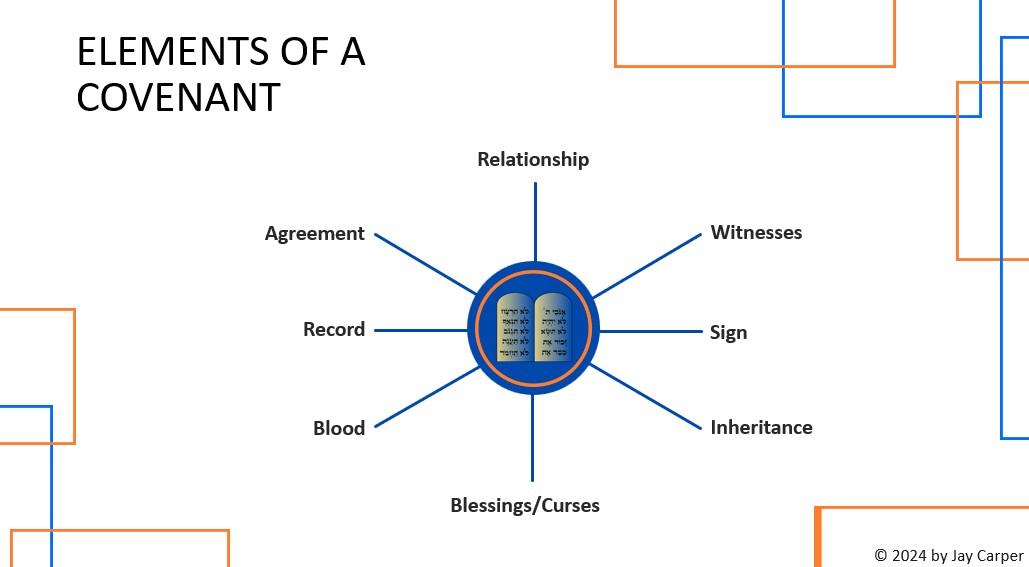
Of course, absence of evidence is not necessarily evidence of absence, but I don’t see how such a covenant would have been possible. A covenant according to the standards that YHWH seems to follow in the Bible requires a sacrifice, witnesses, and agreement between the parties–among other elements.
Eight elements that seem to be common to divine covenants in the Bible. See https://jaycarper.com/covenants for more information.
When YHWH makes a covenant with a group of people, he always operates through an intermediary with legitimate authority over all those with whom he would make the covenant. After the Flood, he made a covenant with all life on earth through Noah. He made a covenant with Abram’s descendants mediated by Abram. At Sinai, he made a covenant with Israel mediated by Moses.
Who was there in the Assyrian exile who had authority to make such a covenant on behalf of all Ephraim? At Sinai all the people agreed to the covenant with YHWH. How would the people of Ephraim agree to a national covenant when they had been scattered across thousands of miles into different lands, languages, and cultures?
In order for the Deuteronomy 24 law to be applicable to Ephraim, she must have made a covenant (“married”) some other god while in exile, and so this the Doctrine of Divine Remarriage must assume that it is true without any evidence. Some teachers have recognized this problem and proposed a solution. They assert that human marriage only requires a sexual union without necessarily including an intent to create a lifelong husband-wife relationship. In other words, sex equals marriage.
But this doesn’t hold up to close analysis either. Becoming “one flesh” physically is a requirement of marriage, but it does not create a marriage in itself. Consider these points:
In 1 Corinthians 6:16, Paul points out that a man who is joined to a prostitute becomes one flesh with her, but that can’t mean that he marries her, because she would already be married to someone else.
Exodus 22:16-17 says that a father can refuse to allow his daughter to marry a man who seduced her, but if sex made a marriage, then she would already have married the man.
In John 4:16-17, Yeshua told the Samaritan woman that she had been married five times, but the man she was living with at that time had not married her. The implication is that she was living with the man as a wife, but had not made a formal commitment of marriage.
In my opinion, equating sex with marriage is a man-made doctrine. If two unmarried people have sex without intending to make a lifelong commitment, they aren’t getting married; they’re committing fornication.
Four: Was Ephraim divorced from her pagan god/husband?
This is another belief that must be assumed since there is no historical or biblical evidence of her marriage to a pagan god, let alone of him later giving her a bill of divorce. I’ve shown how God’s “marriage” to Ephraim was only a metaphor used as a prophetic picture of God’s relationship with his people, and that his “divorce” of Ephraim was also a metaphor.
Gods–even false, pagan gods–cannot make a marriage with a group of people in the same way that a man can with a woman, so the language of marriage and divorce in all of the prophecies concerning God and Israel (unified and separate as Ephraim and Judah) is always metaphorical, not literal.
Five: Does Yeshua’s death nullify the Sinai Covenant?
Based on the following points, I think it’s safe to say that legal bonds–specifically marriage–really do end at death:
In Romans 7:1-7 and 1 Corinthians 7:39, Paul argued that marriage and other legal bonds end at our physical death, and that, through the death of an infinitely perfect man, Yeshua, we are counted as having died and been resurrected spiritually, breaking our spiritual bonds too.
Leviticus 21:1-4 says that a priest may make himself ritually unclean by preparing his immediate relatives for burial, with the exception of his wife. I believe this is because she stops being his wife upon her death, and she is no longer his immediate relative at that point. His responsibility as a priest takes precedence, and he needs to find someone else to perform that task for him.
In Matthew 22:23-30, Yeshua told the Sadducees that a woman was widowed and remarried multiple times will be no one’s wife after the resurrection, again indicating that marriage ends at death.
However, there are three serious problems with saying that this principle nullifies the Sinai Covenant between YHWH and Israel.
First, Romans 7 doesn’t say that death annuls all previous bonds as if they had never existed. Rather, it breaks those bonds so that they no longer restrict the person going forward. If a man dies, his wife is no longer married to him, and she is free to marry another. She is not free, however, to pretend as if she was never married to her late husband and then call her children illegitimate.
Marriage annulment is not a biblical concept.
The law about remarriage in Deuteronomy 24 doesn’t say anything about the husband or wife dying and rising from the grave. Even if such a miracle happened, the former marriages would still be former marriages. Death can’t end what has already ended. The first husband would still not be able to remarry his ex-wife, because he had been married to her at one time, he had divorced her, and she had married another man.
Second, we see from those passages that describe Yeshua interacting with the Father and the Holy Spirit that, although he might be YHWH, he is not all of YHWH. We can’t say that the Son made this covenant and the Father made that covenant when the Bible only says that YHWH made all of them. Israel didn’t make a covenant with the Son of God, but with all of God, and all of God didn’t die at Calvary. Only the Son died.
In John 10:17, Yeshua said, “the Father loves me, because I lay down my life that I may take it up again,” showing that only the Son and not the Father came to die.
In Acts 2:24, Peter said, “God raised him up,” referring to the Son, not the Father or the Holy Spirit.
In Galatians 1:1, Paul wrote that God the Father rose Yeshua from the dead, not that he rose himself or the Spirit from the dead.
I can’t nullify my own legal bonds by cutting off my arm or allowing my son be killed. My death alone can break my legal bonds. “Each one shall be put to death for his own sin,” according to Deuteronomy 24:16, just a few verses after the law concerning remarriage to a divorced and remarried wife.
Third, if Yeshua’s death nullified one legal bond on YHWH, then by the same principle it must nullify all legal bonds on YHWH.
God’s covenant with Noah, in which he promised never to destroy all life by a flood again (Genesis 9:11), has been canceled, and God is now free to send another worldwide flood.
His covenant with Abraham, in which he promised to give Abraham’s descendants land as an “everlasting possession” (Genesis 17:8) has been canceled.
His promise to bless his people when they are faithful and obedient (Deuteronomy 29:1-14) has been made meaningless.
His “everlasting…and secure” promise to ensure David would always have a son to sit on the throne of Israel, a promise that ought to be fulfilled in Yeshua, is now null and void. It was neither everlasting nor secure.
If the Son’s death nullifies a covenant made by the whole of YHWH, then it seems that the death of any individual Israelite ought to nullify any covenant made by the whole nation of Israel. On the contrary, the covenants of Israel are passed down from parent to child, enduring through the deaths of countless generations.
If, on the principle of death ending all legal bonds, Yeshua’s death canceled any covenant of YHWH, then it canceled all covenants of YHWH. Paul was wrong to write that “They are Israelites, and to them belong…the covenants” in Romans 9:4, because those covenants are no longer in effect. We gentiles have not been brought near to the covenants of promise that he referred to in Ephesians 2:12, because those covenants no longer exist.
The death we have through Yeshua, as described in Romans 7, breaks our bondage to the Law (see v4), not God’s bondage to any covenants. His death applies to all people, not just to Ephraim. It is a spiritual death that each one of us undergoes as individuals (not as a nation!) to a debt that we accrued through sins against the Law, not to a covenant that God made with Israel as an act of divine grace.
I meant it when I wrote that I don’t mean to offend anyone by writing this article, but what a horrendous doctrine that makes God out to be a liar and a cheat who makes covenant after covenant, knowing full well that he will throw them all out without having to fulfill their ultimate promises! On what basis should we trust such a god to keep any of his promises? Maybe he has created some other legal loophole that we don’t know about.
Six: Did Yeshua resurrect, in part, to enable YHWH’s remarriage to Ephraim?
This question hardly needs answering at this point. YHWH did not literally marry or divorce Ephraim and so he has no need to remarry her. He made numerous covenants with Israel and individuals and clans within Israel, each one enhancing a relationship which already and continued to exist. Ephraim, despite her many sins, was never outside of her covenants with God, but only temporarily repudiated and exiled as a corrective measure. None of those covenants will ever end until heaven and earth themselves are ended.
So why did Yeshua have to die?
Yeshua’s death had at least two major effects: He became the sacrificial victim that inaugurated the New Covenant and his blood removes the spiritual debt of sin from his people
The New Covenant
As I demonstrated in the Covenants of Israel video series (Rumble link) and noted in the illustration above, divine covenants are established by the blood of a sacrificial victim. You can see this in the examples of God’s covenants in the Old Testament, but Hebrews makes it explicit.
…for where a covenant is , the death of the covenant-victim to come in is necessary, for a covenant over dead victims is stedfast, since it is no force at all when the covenant-victim liveth, Hebrews 9:16-17 YLT
(My apologies for quoting Young’s Literal Translation, but most English Bible translators introduce too much commentary in these verses because they don’t understand covenants. Young’s is hyper-literal–often so literal that it’s difficult to understand–so translator bias or cultural ignorance is less of a factor.)
The New Covenant was established and was fully in force at the cross. It includes promises that haven’t been fulfilled yet, but all covenants involve ongoing fulfillments. The forgiveness and full restoration of the people of Israel to the land, the defeat of all Israel’s enemies, the personal reign of the Messiah in Jerusalem, a through understanding of God in the hearts of his people, and the resurrection and judgment of all people are all aspects of the New Covenant that we have yet to see, but their future reality was guaranteed when Yeshua said “It is finished”.
Forgiveness of Sin
I won’t pretend to understand exactly how spiritual accounting works. I don’t even understand financial accounting!
Paul explained in Romans 5, Colossians 2:13-14, and Ephesians 1:7 that our transgressions against God’s Law created a spiritual debt that we could never repay. Although the penalty was both physical and spiritual death, our blood could never elevate us to the infinite level of righteousness required to be reconciled to our Creator. Animal sacrifices could only temporarily remove the uncleanness of sin from our flesh and primarily covered sins of weakness, ignorance, and accident. They had no impact at all on the spiritual debt incurred by sins of rebellion.
YHWH’s solution was to send Yeshua to live a perfectly sinless life and give up his life to pay that debt for us. His blood zeroes out (reconciles/justifies) our spiritual balance books, in a way bringing us through death into new spiritual life through him. His perfect righteousness now counts in God’s books as ours.
Yeshua’s blood doesn’t nullify any covenants made by YHWH with anyone. It buys the debt we owed to the Law because of our sins, justifying our spiritual balance sheets. In his death we have obtained forgiveness, whether we understand how it works or not.
And in his resurrection, he took authority over death itself. We, who sincerely pledge our faithfulness to him, accepting the forgiveness of our debt and his lordship over our lives, have been given a promise of eternal life, whether we can wrap our minds around living forever or not.
Update 7/9/2026: I wrote this article 7 years ago, and my understanding of covenants and circumcision has evolved significantly since then. Check out this post that links to my more current thoughts on this topic: All About Biblical Covenants.
In speaking of a new covenant, he makes the first [old covenant] obsolete. And what is becoming obsolete and growing old is ready to vanish away.
Hebrews 8:13
In the course of a respectful (not sarcasm!) conversation on Facebook, a friend made this statement:
Based on other interactions, it’s clear that you hold that the New Covenant did not make the Old Covenant obsolete, and therefore you must have an alternative explanation to Hebrews 8:13 which – in English – appears to plainly state that the New Covenant DID make the Old Covenant obsolete.
I thought readers of American Torah might also appreciate my reply:
It depends on what you mean by “obsolete”. Whatever the author of Hebrews meant, it seems that he didn’t mean it was completely gone (annulled) at the time he wrote, decades after Jesus’ resurrection, because he wrote that the “old is ready to vanish away”, not that it had already vanished away.
In my opinion, Hebrews is the second most misunderstood book in the Bible (Revelation being the first). I’ll use a couple of metaphors to explain two core concepts that the writer discusses.
One, the writer compares Jesus’ priesthood with Aaron’s. Two, he compares the New Covenant with the Old (Sinai) Covenant. (I say one and two, not first and second, because he jumps back and forth and all around in making his points, which convinces me that Paul was the author, possibly through an intermediary.)
Two Priesthoods
Metaphor One: Think of the two priesthoods as a hammer and screwdriver. A hammer is great for driving nails, but terrible for driving screws. In fact, if you try to use a hammer to drive a screw, you’re likely to make a mess of the wood and break the screw, possibly a finger as well. Hammers were intended to drive nails, and that’s fine as long as you’re only nailing things together. But if you have a new task that requires driving screws, you’re going to need a new tool to drive them.
If the task at hand involves certifying a leper as clean or making a burnt offering in worship, you go to Aaron. That’s what he’s good for. The Aaronic priesthood is fine for what it does, but it was never capable of mediating eternal salvation. Aaron was completely incapable of permanently removing the stain of sin and restoring us to a right relationship with God for all eternity. If that’s your goal, then you need a new tool, a new priesthood: Jesus.
Hebrews doesn’t say that the Melchizedek Priesthood replaces the Aaronic. It says that, if you are dealing with a different covenant, altar, and domain, then you need a different priesthood too. One doesn’t replace the other, but operates in parallel on a different, higher level.
Two Covenants
Metaphor Two: Picture the Sinai Covenant as a full moon and the New Covenant as the rising sun. As the sun rises, the moon doesn’t cease to exist. It continues to “rule the night” and to influence the tides, but it does fade in comparison to the much brighter light of the sun. The moon gives light both at night and in daytime, but when the sun rises, the moon’s light becomes superfluous–osbsolete, one might say–as if it has faded with age.
Just like the moon, the Old Covenant has no light of its own. It is a reflection of a much greater covenant, that the Scriptures anachronistically call the New Covenant. It’s “new” because, although it was promised and existed in principle from the very beginning, the sacrificial blood that sealed it was shed relatively recently, and it is still not fully risen. Until the promise of Jeremiah 31 (quoted in Hebrews 8) is fulfilled, we can’t really say that the New Covenant has reached its zenith:
“And they shall not teach, each one his neighbor and each one his brother, saying, ‘Know the Lord,’ for they shall all know me, from the least of them to the greatest.”
Hebrews 8:11 & Jeremiah 31:34
When Will the New Covenant Be Fully in Effect?
The New Covenant was fully established from the moment of Yeshua’s death, but–like all other covenants–it contains promises that are both ongoing and for future fulfillment.
According to Jeremiah and Hebrews, one of the distinctive qualities of the New Covenant is that God’s Law will be written on the hearts of the people. They will no longer need a written Law because they will know God’s character instinctively, and will know right from wrong without having to be told. This presupposes that the Law as written in the Old Covenant is an accurate reflection of God’s character and what he considers to be moral behavior.
As we internalize his Law, we obey what the Law says without having to continually reference the written word. This absolutely does not mean that we are free to throw out all of the moral standards detailed at Sinai because we have the Law written on our hearts. If we believe that, then it is clearly NOT written on our hearts and we still need to be told what to do.
“The Law was written for sinners, not for the righteous.” But “If any man says he doesn’t sin, he’s a liar and the truth isn’t in him.”
I believe that when–or sometime after–Jesus returns, he will complete the process of fulfilling this promise of the New Covenant. We will finally have God’s Law fully written in our hearts and nobody will need to tell anyone “Know God” because we will all know him at every level.