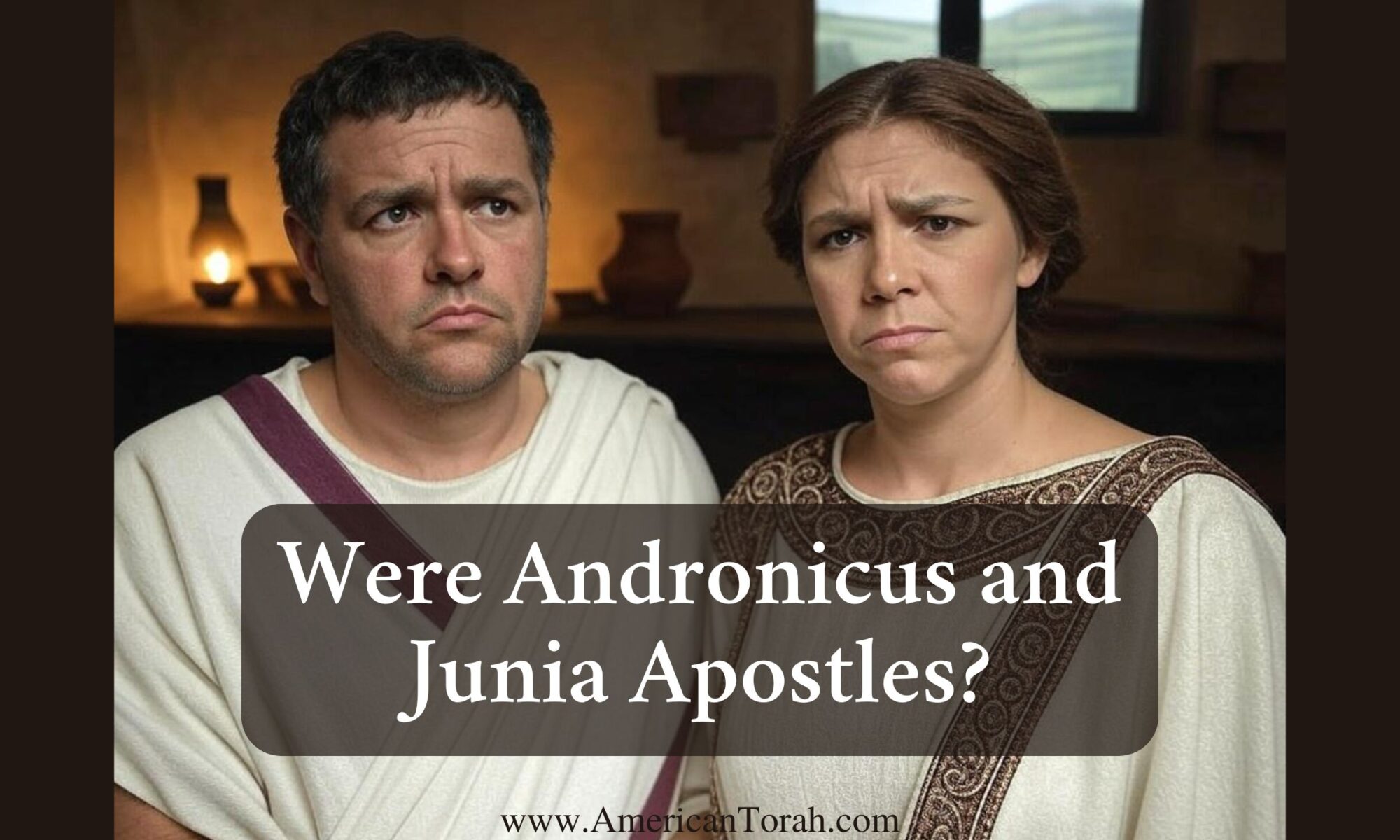
Were Andronicus and Junia Apostles?

Greet Andronicus and Junia, my kinsmen and my fellow prisoners. They are well known to the apostles, and they were in Christ before me.
Romans 16:7 ESV

Salute Andronicus and Junia, my kinsmen, and my fellowprisoners, who are of note among the apostles, who also were in Christ before me.
Romans 16:7 KJV

This verse is the center of a surprising amount of controversy. Note that the English Standard Version says that Andronicus and Junia were well known to the apostles, while the King James Version says they were well known among the apostles. That one little preposition changes the meaning considerably.

Where Andronicus and Junia well-known apostles? Or were they well-known to the apostles? If they were apostles, “well-known” implies that they were on a par with the Twelve Disciples and possibly as notable as James and John. This would be especially sensational, since Junia was almost certainly a woman.

Andronicus and Junia appear to have been a married couple and were probably of the tribe of Benjamin, the same as Paul (See Romans 11:1.), or even more closely related to him. Several Jews are mentioned in this chapter already, but these are the only ones Paul calls his “kinsmen”, so I think this must refer to something more than being fellow Jews.

Paul also calls them his “fellow prisoners”. He implies in 2 Corinthians 11:23, written several years before this letter, that he had been imprisoned on multiple occasions. The only confinement prior to writing Romans that we have certain knowledge of is at Philippi in Acts 16:24, but there is no mention of Andronicus and Junia nor any other believer in prison with him apart from Silas. It’s likely that many significant events of his missionary journeys were not recorded so that they were imprisoned with him somewhere else, or he meant that they shared the experience of being imprisoned but not necessarily at the same time and location. Since Paul says that they were “in Christ” before him, it’s even possible that they were victims of Paul himself during his persecutions of the Christians in Judea and nearby provinces.

The term apostle (apostolos, αποστολοις) doesn’t necessarily imply a position of general or supreme authority. It literally means “messenger” or “deputy” and can refer to anyone who is sent on any kind of mission as a representative of another. Missionaries, messengers, errand boys, and diplomatic envoys can all be called apostles.

There are two questions to answer in this instance. First, were Andronicus and Junia apostles themselves or merely well known to the apostles. Second, did Paul use “apostle” in the more generic sense or did he use it as a title of office for those disciples of Yeshua who had been given special authority over his Kingdom. These questions are linked because the answer to either one likely dictates the answer to the other. As I will explain, either this couple were known to the apostles and Paul used the word in the sense of an ecclesiastical office or else they were well known apostles and Paul used the word in the more general sense of anyone sent on a mission for another. I lean very strongly to the former.

If they were notable among the Apostles, this would imply that they were at least on a par with the lesser known of the original Twelve Disciples, yet neither Andronicus nor Junia are mentioned anywhere else in Scripture. They left no writings, not even any hints that they had ever written anything. They are not mentioned by any of the first century or second century Christian writers and rate only two mentions in the first four centuries of Christian literature:

  1. In his Commentary on the Epistle to the Romans (c. 246 AD), Origen of Alexandria speculates that they might have been among the 72 disciples sent out by Yeshua in Luke 10. Most of the original Greek has been lost, and this survives only in a Latin translation. Since Origen had only his own personal speculation and no personal knowledge or documentary evidence, this is essentially meaningless.
  2. John Chrysostom wrote in his Homily 31 on Romans, “How great the devotion of this woman [Junia], that she should be even counted worthy of the appellation of apostle”. However this was written 350 years after Paul died, and Chrysostom also asserts in the same writing that Paul had never been imprisoned before, which is clearly contradicted by Acts 16. Considering Chrysostom’s temporal separation from the facts, his factual errors, and his extreme antisemitism, I don’t consider Chrysostom to be a reliable witness.

If they were so notable, why did no one leave any notes about them?

If this were the only evidence available, I would be inclined to conclude that Andronicus and Junia were notable to the Apostles rather than among them, but there is at least one other significant factor.

Michael Burer published two papers on the use of episemos (notable, επισημος) in ancient and medieval Greek literature. The first paper, with Dan Wallace, titled “Was Junia Really an Apostle?” analyzed “a few dozen passages” that seemed most relevant to the circumstance described in Romans 16.[1] The authors concluded that, “The collocation of επισημος with its adjuncts shows that, as a rule, επισημος with a genitive personal adjunct indicates an inclusive comparison (‘out-standing among’), while επισημος with (εν plus) the personal dative indicates an elative notion without the implication of inclusion (‘well known to’).” In other words, when episemos is in the dative case and includes en (επισημοι εν), as in Romans 16:7, it always means “notable to” and not “notable among”.

The second paper, titled “ἘΠΙΣΗΜΟΙ ἘΝ ΤΟΙΣ ἈΠΟΣΤΟΛΟΙΣ In Rom 16:7 As ‘Well Known To The Apostles’: Further Defense And New Evidence”, examined more than 100 additional passages when it became clear that the primary objection to the first study was the limited number of source texts.[2] This second article concluded that “Seventy-one new texts demonstrate that Paul could have readily used επισημος plus the genitive to show that Andronicus and Junia were “notable among the apostles.” Thirty-six new texts, all but one of which parallel Rom 16:7 exactly in grammatical structure, provide further evidence that Paul intended επισημοι εν τοις αποστολοις to mean that Andronicus and Junia were ‘well known to the apostles.’”

Although I am not a Greek scholar by any conceivable metric and many actual Greek scholars disagree with me, it seems to me that Paul was almost certainly not calling Andronicus and Junia apostles. Rather, they were both well known to the Apostles, probably because of their maturity in the faith and willingness to endure persecution for the name of Yeshua.

This also leads me to conclude that Paul was using the term “apostle” to refer to those men in the most respected and authoritative positions in the first century community of believers: those who had known Yeshua personally and possibly their closest disciples. This would include the Twelve Disciples, Paul, and possibly those who remained of the Seventy-Two Disciples along with well-known men like Timothy and Barnabas.

I don’t believe that Paul always used the term in this sense. The word apostle can refer to any person who is specially commissioned by another to carry out a mission or relay a message. In this broader sense, every prophet and missionary is an apostle of Yeshua, and I would not object to calling Andronicus, Junia, Phoebe, Prisca, and Aquila “apostles”. As when he uses law (nomos), we have to use contextual clues and common sense to tell us when he means it narrowly (the Law and the Apostles) or broadly (law and apostles). If Paul considered this couple to be among the Apostles, in the narrower sense, then this verse could have a major impact on the debate concerning the role of women in positions of ecclesiastic authority, but that interpretation doesn’t appear to be supported by the text.


[1] Michael H. Burer and Daniel B. Wallace, “Was Junia Really an Apostle? A Re-examination of Rom 16.7,” New Testament Studies 47 (2001): 76-91.

[2] Michael H. Burer, “ἘΠΙΣΗΜΟΙ ἘΝ ΤΟΙΣ ἈΠΟΣΤΟΛΟΙΣ In Rom 16:7 As ‘Well Known To The Apostles’: Further Defense And New Evidence,” Journal of the Evangelical Theological Society 58, no. 4 (2015): 731-55.


To Serve and Protect the Garden

Adam was placed in the Garden of Eden to work it and keep it. What does that mean for our relationship to Creation and Creator?

YHWH Elohim took the man and put him in the garden of Eden to work it and keep it.
Genesis 2:15

Adam was not placed in the Garden merely to water plants. The Hebrew word translated as “to dress” in the KJV and “to work” in the ESV is abad. It’s the same word used throughout the Old Testament for the Hebrews serving God or a slave serving his master. “To keep it” follows in the same vein. This is the Hebrew word shamar which means to guard and protect. Adam was to serve the Garden by helping it become the best that it could be, and also to guard it against anything that might try to harm it.

The King James rendering of “to dress it and to keep it” could just as literally be translated “to serve it and to protect it”, interestingly very similar to a phrase found on many police cars in America: “To serve and protect.”

Scripture describes many different kinds of servant relationships, but “serve” in this context doesn’t mean that Adam was a slave to the Garden. In fact, Genesis 1:26 says that God intended to give mankind authority over the whole earth. Adam’s divinely appointed task of caring for the Garden didn’t make him subordinate to the Garden. Rather it was a consequence of his authority over it. All authority is given, in part, to enable the bearer to care for his charge.

Obey your leaders and submit to them, for they keep watch over your souls, being accountable for them to God. Allow them to do so with joy and not grief, because that wouldn’t be good for you either.
Hebrews 13:17 (Paraphrased)

Mankind was never intended to be an absolute ruler over either the Garden or the rest of the earth. We were given authority over creation so that we might serve and protect it. The earth serves us, and we serve it, in turn.

God didn’t ad lib creation. His intentions didn’t change halfway through the week nor even after Adam was created. God programmed a drive to accomplish Adam’s first assignment into the very genetic code of mankind, both men and women. Men are driven to provide for and protect their wives and children. Women are driven to protect and nurture their children. We instinctively want to protect the vulnerable and help the weak become stronger.

In our sin-corrupted state, that drive is often abused, misdirected into tyranny. Some people may abuse the earth, destroying today with no care for tomorrow. Some men may dominate their families through physical intimidation and some women may treat their children as little more than annoying accessories to a lifestyle.

However, we can’t allow such abuses to rob us of the strengths that God intends for us to use. We have an obligation to use the resources that God has given us for his purposes. To neglect that obligation is as much a sin as it is to abuse it.

Seven Patterns of Marriage in the Bible

Seven patterns of marriage in the Bible. Concubines, wives, handmaids, levirate, etc.

This isn’t a how-to article. I’m not going to tell you how to have a happy or fulfilling marriage. Marriage advice is vital. No matter how smart or “experienced” you think you are, you can’t figure it out all on your own. You need help.

That’s not this. This is more of a “how-did” kind of article. Good, bad, or ugly…this isn’t about managing the dynamics of person-to-person relationships. It’s about categories of marriage that nobody else seems to want to talk about.

That’s understandable. In modern America today, for the most part, a man and a woman date, get engaged, and get married. That’s pretty much how everyone does it. (For the moment, set aside the world’s wickedness and rare outliers like surrogates.)

But I’ve got some foreign and uncomfortable news for you: Modern America is an anomaly. Most people throughout history–most people in the rest of the world right now–don’t do marriage the way we do. That includes the ancient Hebrews who wrote the Bible and for whom it was written.

Marriage Is Central

The concept of marriage is central to God’s portrayal of his relationship with his people. Adam was made in his image, and from Adam, God extracted Eve, making the two together a more complete image of God than either one separately. Over and over, he describes his relationship with his people as a marriage.

The wedding feast…The bride of Christ…Idolatry is the same as adultery.

If God uses marriage as a metaphor of his relationship with us throughout the Bible, it seems to me that it’s important for us to understand how the Bible portrays marriage.

That’s not to say that every marital arrangement in the Bible is a pattern we ought to follow. The Bible doesn’t hide its characters’ bad choices. In fact, it frequently–almost always–highlights them in order to give us examples of what not to do.

But that’s also not to say that every marital arrangement in the Bible that doesn’t conform to our cultural expectations of right and wrong is actually wrong. God doesn’t care about our cultural standards. He communicates with us where we are, but he doesn’t conform his moral standards to ours. If God says something is morally acceptable, then it is. If he says it’s not morally acceptable, then it’s not. Our preferences carry no weight.

God determines right and wrong. We don’t.

It’s tempting to think that God merely “winked” at the sinful nature of foreign things like concubinage and polygamy, which appear on the surface to be unfair to women, because the ancient Hebrews didn’t know any better, but that was never a consideration for any of the laws that he gave. God didn’t hesitate to give a law against making and worshiping statues of him, even though the Hebrews obviously didn’t know that they weren’t supposed to do that. They struggled with idolatry for another thousand years after Sinai, so suggesting God didn’t outright ban any of these marital arrangements only because the Hebrews wouldn’t have understood is absurd.

Slavery…bride price…capital punishment…polygamy…genocide…. Like it or not, these are things that God allows in his Law under some circumstances, and our gut feelings about how right or wrong they are is completely irrelevant to the reality of their rightness or wrongness.

With that understanding, I’d like to describe seven marital arrangements that you will encounter while reading the Bible, especially the Old Testament. Not because I think we need all of these arrangements now, but because I don’t think you can fully understand the Scriptures without understanding the culture and mindset of the people who wrote them. I am neither promoting nor condemning any of these practices. I’m just telling you how marriage used to work and what God allows in his Law. “Allows” does not equal “desires”. “Allowed” does not mean “ideal”.

  1. Betrothal
  2. Free Marriage
  3. Concubinage
  4. Levirate Marriage
  5. Handmaid Concubinage
  6. Slave Marriage
  7. Captive Concubinage

Betrothal is somewhere between our “engagement” and marriage. Free Marriage is closest to what we call “marriage” today. Levirate Marriage is tied to life in the land of Israel. The other four are all variations of concubinage. I’ll explain what that means later, but it’s important to know that Biblical Hebrew doesn’t have a separate word for any of these, except perhaps for “concubine”, and that word isn’t always applied to concubines. In fact, it doesn’t have specific words for marriage or wife at all.

The Hebrew word for “wife” used in the Bible is ishah (אשּׁה), which really just means “woman”. Except for the Levirate Marriage (yabam / יבם), there is no single word for marriage or marry. For women, the Bible uses phrases like “become a woman” or just “become”. For men, it most often says “master”. For readability, almost all English translations render these terms as some variation of “wife” or “marry”, depending on the context. That’s fine as long as the reader knows this, but if you don’t, I think it can often lose meaning or gain unintended meanings.

The differences between these marital arrangements are fuzzy and often overlap. A captive woman might become a handmaid to a Hebrew wife and then be given to the husband as a surrogate. A concubine might be a man’s only wife and if he dies childless, she might become a levirate wife to his brother. It can be complicated.

The ancient Hebrews probably didn’t categorize their relationships in the way I do below, but I think applying labels and descriptions will help the modern Bible student understand what he’s reading in the Scriptures.

Betrothal

Betrothal is similar to what we think of as engagement, but wasn’t so easily broken. In fact, betrothal was considered tantamount to marriage and could only be broken by a divorce. A woman who was betrothed to one man and had a sexual relationship with another would be guilty of adultery.

A betrothal would begin when a man and woman (and her father) agreed to marriage. Under normal and ideal circumstances, the man would give her and her family a bride price–a substantial gift that would likely be shared between the bride and her father or eldest brother. The woman’s family would reciprocate with a dowry of land, livestock, or some other tangible form of wealth. If her husband ever abandoned or divorced her unjustly, her family would probably try to get her dowry back from him.

Joseph’s betrothal to Mary (Matthew 1:18-19) is an example. The primary laws governing betrothal (apart from to whom you are allowed to marry) are in Exodus 22:16-17, Deuteronomy 20:7, and Deuteronomy 22:23-29.

Free Marriage

A free marriage is one in which a man marries a free (not a slave) woman and receives a dowry as part of the marriage agreement. Although we don’t consciously think of bride prices and dowries, this is what we usually have in mind when we talk about marriage.

If the man paid the woman and her family a bride price and did not receive a dowry in exchange, then she would probably be considered a concubine instead. Recall the story of Jacob’s marriages to Leah and Rachel. He agreed to work seven years for each of them, and if that had been the full transaction, they would have been concubines instead of full wives. When Jacob suggests that it’s time they left his father-in-law, both of the sisters replied by saying “Our father sold us and devoured our money”. They were complaining that Laban had sold them to Jacob for labor and had used up their dowry for himself. Fortunately for them, God intervened and miraculously extracted their dowry from Laban in the form of striped and spotted sheep, ensuring that they were free women. See Genesis 31.

Abraham’s marriage to Sarah, Isaac’s marriage to Rebekah, and David’s marriage to Abigail are all examples of free marriage.

Concubinage

In short, a concubine is a wife who is also a purchased slave, usually belonging to the man to whom she is married. In many ancient cultures, such as the Greek, a slave girl could be used by her master however he saw fit, including for prostitution, but that kind of behavior is forbidden by Torah.

If a man owned a female slave who was married to someone else, usually another slave, and if he had sex with her, then he could be executed as an adulterer. A man could take any of his unmarried, unbetrothed slave girls to be his own concubine, but that would become a permanent relationship. She would be his wife, and he couldn’t then toss her aside or give her to someone else like a party favor.

The primary difference between a concubine and a free wife was her legal/economic status as a slave. She had an added layer of economic obligation to her husband that a free wife did not. This had a huge impact on her social standing and on her options if he were to abandon or divorce her, but–contrary to popular mythology–it did not change the fact that she was his wife. She did not stop being a slave when she became his wife, nor did she stop being his wife just because she was also a slave. God required that he provide for her in the same way that he provided for a free wife. See Exodus 21:10.

The children of a concubine did not inherit her status as a slave if her service was owned by her husband directly, but probably would not be able to inherit as a firstborn unless he had no children by a free wife.

Abraham’s marriage to Keturah (Genesis 25:1; she was not the same as Hagar) and the unnamed Levite’s marriage to the unfaithful woman who was murdered (Judges 19) are examples of concubinage.

Levirate Marriage

The word “levirate” isn’t related to the tribe of Levi. It comes from a Latin word that means “brother-in-law”. In this type of marriage, if a man married a woman and then died without having any children, one of his brothers was to marry his widow and their first-born son would become the legal heir of the deceased. The woman was fully a wife to her new husband, just as she had been to her late husband.

Levirate marriage existed to ensure continuity of inheritance in the land of Israel. In Biblical language, a “name” is more than just a label. A person’s name is their character, reputation, faithfulness, and influence in the community. The story of Zelophehad’s daughters in Numbers 27 and 36 shows that a man’s inheritance in God’s promises is an important part of his name, and the levirate marriage is one way that God ensures his name isn’t lost from Israel.

Exactly how this kind of marriage played out in real life is difficult to discern from historical records, including the Bible, but we can extrapolate a few things from the limited information we have:

  • The deceased’s brother would inherit his land if he died unmarried and without any children, but the brother couldn’t simply take the land if the man had been married and was still childless. In order to take over the land, the brother needed to marry the widow and produce an heir for the deceased. The land would then belong to that heir when he came of age, so the brother would only have control of the land for that period of time. His other children would divide his original inheritance among themselves after his death, while the firstborn of his brother’s wife would be the sole heir of his brother’s estate.
  • There were no exceptions for a man who was already married, so this could result in conflict and complications in his house. A second wife doesn’t just add a second relationship, because she will have to be integrated into the whole family.
  • The widow might also come with obligations to her family, including any stipulations that might have been included in her marriage agreement.
  • The deceased’s brother could refuse to marry the widow but such a refusal would cost him honor and social standing. The levirate obligation would then pass to another brother.
  • If the deceased had no brothers or none of his brothers were willing to marry his widow, it seems from the story of Ruth that more distant male relatives might have the option to marry her and produce an heir for the deceased, although that isn’t explicit in Torah.

Tamar’s marriage to Judah’s three sons (Genesis 38:6-14) and Ruth’s marriage to Boaz (Ruth 3-4) are examples of levirate marriage. See Deuteronomy 25:5-10 for the laws governing levirate marriage.

Handmaid Concubinage

Female slaves weren’t only purchased as concubines. Frequently they were purchased as laborers or as another woman’s personal maidservant, also known as a handmaid. The mistress of such a slave could give her to her husband as an additional wife–usually because she was unable to conceive or bear any children of her own–but this didn’t remove the economic obligation of the slave to her mistress. Hence Abram’s response to Sarai in Genesis 16:6 when she complained about Hagar’s behavior: “Look, your servant is under your authority; do to her as you please.”

A wealthy man’s house could get quite complicated if he had multiple wives, each with their own handmaids. Each wife would constitute a sub-house within the house of the patriarch, and each handmaid and her children would be a sub-house within the house of her mistress. The children of the handmaid were counted as the children of the mistress in some legal sense that’s difficult to make out from scripture, but treated as children of the handmaid in household practice. As with the children of a simple concubine, any sons of the handmaid would likely be passed over as the firstborn in favor of a son born to a free wife, if there was one.

Abram’s marriage to Sarai’s handmaid Hagar (Genesis 16:1-4) and Jacob’s marriages to Rachel’s handmaid Bilhah (Genesis 30:1-5) and Leah’s handmaid Zilpah (Genesis 30:9-10) are examples of handmaid concubinage.

Slave Marriage

In God’s Law, the master-slave relationship takes precedence over the husband-wife relationship. If a man marries his female slave, she becomes his wife, while remaining his slave. If a master gives his female slave to a male slave as his wife, they both remain slaves, and their children will belong to their master.

This is probably one of the most difficult elements of God’s Law for modern Americans to accept, but we don’t get to define right and wrong. That is God’s purview alone.

God requires that Hebrew slaves be set free in their seventh year, but non-Hebrew slaves and their children can remain slaves in perpetuity. If the male slave above is a Hebrew and set free, while the woman is not a Hebrew or has not reached her seventh year, she would not be able to leave with him.

At that point, he can decide between three options:

  1. He can walk away, leaving his wife and children behind.
  2. If his slave-wife is a Hebrew, he can wait for her to reach her seventh year, so that she and her children can join him in freedom.
  3. If she is not a Hebrew or if he doesn’t want to wait for her seventh year, he can choose to remain with his master for life.

I’m not aware of any specific examples of this kind of marriage in the Bible, but it is described in Exodus 21:2-6 and Deuteronomy 15:12-17.

Captive Concubinage

Scripture records numerous instances in which Israel captured the women and children of an enemy people. Although this sounds like a horrible thing, the alternative is that they be abandoned to pagan captors, who did not have God’s instructions on how to treat slaves, or to probable starvation. The most humane thing to do after a war in which all or most of the enemy’s men have been killed, is to take the survivors under your protection, and the only practical way to do that is to put them to work.

Many (most?) of those survivors would become handmaids or field workers, but an Israelite warrior also had the option of marrying a newly widowed or unmarried woman. This would make her a captive concubine. He was not allowed to take her immediately, though. In Deuteronomy 20:13-14 and 21:10-14, God gave instructions intended to add a layer of protection for everyone.

Her new master was required to shave her head, trim her nails, and wait thirty days before he could marry her. This gave her time to mourn her family, time to know if she was pregnant or sick, and time to evaluate her character. If, at the end of that time, the man realizes that he let his passions overrule his good sense, or he changes his mind for some other reason, he is required to set her free. He humiliated her in this process and the recompense is that she had shelter in his house for at least a month and cannot then be made a slave to anyone without her consent. She was free to remain in Israel as a widowed sojourner or make her way to some other land or relatives if she had any.

Although I don’t believe the Bible gives any specific details of these relationships, the sacking of Shechem in Genesis 34:29 and the remnant of Midian in Numbers 31 show two instances when a large number of women were captured in war, some of whom almost certainly became concubines to the victors.

Shadows of the Divine

As I mentioned earlier, throughout the Bible, God uses marriage as a metaphor of his relationship with his people.

Since we are most familiar with the concept of the free marriage, it’s relatively easy for us to understand that metaphor. We are the “bride of Christ”, chosen and betrothed, waiting for the marriage supper of the Lamb. But it’s easy to miss the exchange of gifts: the bride price of the Son’s life and the dowry of gold, frankincense, myrrh, spikenard, and spices. These seem like paltry tokens compared to what we were given, but there is no requirement that the dowry and bride price necessarily have to be of equal value. One could say that we give him our lives in exchange for his, but dedicating our lives to him is the marriage itself, so I don’t think that can be considered a dowry.

When we were transgressors, we were subject to the condemnation of the Law, debtors to the Law under a burden we could never pay. He betrothed us to him while we were still hopelessly in bondage, but then he forgave our debt and redeemed us from bondage so that we could be a free bride.

The freed slave who loves his master and his family and binds himself permanently for their sake of his family. This is connected to the believing spouse in 1 Corinthians 7:14 whose family is sanctified to God because of his faith.

All of the laws governing betrothal, marriage, and servitude in scripture are shadows of greater things designed and implemented in heaven. The shadows are patterns intended for our enlightenment. By studying God’s instructions for marriage–even those marital arrangements that aren’t practiced in our culture–we can learn more about him, ourselves, and our relationship to him.


Men Who Fear God: Yitro’s Rules for Leadership

Jethro's qualities of leadership

Moreover, look for able men from all the people, men who fear God, who are trustworthy and hate a bribe, and place such men over the people as chiefs of thousands, of hundreds, of fifties, and of tens.
(Exodus 18:21)

In this passage, Jethro (Hebrew: Yitro) had observed Moses working himself to death by attempting to address every complaint of the millions of Hebrew refugees by himself. He wisely suggested that Moses needed some help and gave some specific instructions on how to select his helpers. His instructions were essentially the same as those Paul gave to Timothy and Titus many centuries later:

Therefore an overseer must be

  • above reproach
  • the husband of one wife
  • sober-minded
  • self-controlled
  • respectable
  • hospitable
  • able to teach
  • not a drunkard
  • not violent but gentle
  • not quarrelsome
  • not a lover of money
  • manage his own household well
  • keeping his children submissive
  • not a recent convert
  • well thought of by outsiders

(From 1 Timothy 3:2-7)

…able men… These men were to be “able” or chayil. They must have proven their ability by success in business, community, family, and war. They should be men of both knowledge and ability. They don’t need to be supermen, but their families should be well ordered, their businesses more successful than not, and their personal finances in order. Untried men should not be placed in positions of authority.

…men who fear God… Ability alone is not enough to make a great leader of God’s people. He must also be a man of God. He should have high personal standards, a healthy prayer life, and not embroiled in sordid controversies. There are many fine atheists and agnostics in the world–at least by the world’s standards–but they are not qualified to lead God’s people.

…who are trustworthy… Not men who are apt to deceive their way into office. The pathological dishonesty of the vast majority of modern politicians is obvious to anyone with eyes to see and ears to hear. They lie and they lie and they lie, bolder every year, yet they remain in office. That we continue to elect such men and women into leadership is proof of the old adage: We get that government which we deserve.

…hate a bribe… Offices with power are rife with all sorts of opportunities to advance one’s own interests. It is a good thing to desire to lead God’s people, but not to desire it overly much. Remember Yeshua’s words: The first will be last, and he who would lead must serve. Any system resembling a democracy, unfortunately, must favor dishonest seekers of power and fortune.

There are no perfect people in the world. Everyone has flaws. Everyone has weak moments when we make poor choices, set a poor example, and think terrible thoughts. But it’s one thing to be flawed and something else entirely to be a liar, a thief, or a murderer.

Garments of Authority and Submission

Veils, robes, and mantles are marks of authority and submission.

Now Israel loved Joseph more than any other of his sons, because he was the son of his old age. And he made him a robe of many colors.
Genesis 37:3 ESV

Although Moses did not tell us so, I am certain that this garment was not simply a coat, but a mantle like Elijah’s, a badge of office and an emblem of divinely delegated authority. I also suspect that it was made in exactly twelve colors, one for each of the tribes of Israel over which Joseph would be given authority. Recall that the High Priest’s breastplate, as well as the foundations and the gates of the New Jerusalem, contained twelve precious stones of twelve different colors explicitly representing the twelve tribes. It was an independent confirmation of the prophecy which Joseph was soon to receive in a dream.

This Torah portion (Vayeshev, Genesis 37-40) is full of clothes and head coverings.

  • Reuben tore his clothes (Genesis 37:29)
  • Joseph’s brother dipped his robe in blood and presented it to their father (Genesis 37:33)
  • Jacob tore his garments (Genesis 37:34)
  • Tamar removed her widow’s garments and donned a veil (Genesis 38:14-15)
  • Tamar removed her veil and donned widow’s garments (Genesis 38:19)
  • Potiphar’s wife caught Joseph by his garment and used it to frame him (Genesis 39:12-16)
  • Pharaoh’s baker dreamed of three baskets on his head (Genesis 40:16-19)

Garments and coverings of all kinds are prominent throughout Scripture and almost always have a deeper meaning than what can be read only on the surface.

For example, when Moses came down from Mt. Sinai, his face glowed and he wore a veil over his face to hide the glory of it from the Israelites. (Exodus 34:29-35) I was taught that this was a purely pragmatic act, that he had absorbed so much of God’s glory that nobody could stand to look at it, but I think that’s only partly correct.

When Moses was engaged in God’s business–for example, when he spoke the Torah to the assembled Israelites and when he was in the tent communing directly with God–he removed the veil. When he was about more mundane business–for example, judging legal cases and performing administrative duties in the camp–he wore the veil. The key distinction is not whether or not the person in front of him could stand to look at him, but whether or not it was appropriate to display God’s glory directly.

I think it was important that he did not appear to be speaking for God at every waking moment. He wasn’t a replacement god–as much as he must have seemed so both to Pharaoh and Israel–but an emissary for God. He had to hide his face so that the Israelites would not be tempted to worship him or to take every word he spoke as divine law. Removing the veil for Moses in the wilderness was like the Catholic Pope speaking ex cathedra. He removed the veil when he spoke God’s Law because he wanted Israel to see God speaking in the rays of light that shone from his face.

Coverings in Scripture are often emblems of authority and protection: headcoverings, veils, mantles, robes of state, wraps, hangings, bedding, shadows, gold plating…even tree branches and pitch are used in this way.

Headcoverings and mantles are two of the most obvious as well as two sides of the same coin. How the covering is worn or used advertises the bearer’s relationship to the authority.

Worn on the head, they indicate submission to the authority of another, like a military cover. One who is under authority is obligated to obey, but is entitled to protection and provision. To a certain extent, he shares in the power of that authority.

Some examples of coverings representing submission to authority or protection:

  • Ruth covered herself with a corner of Boaz’s tunic (tallit?) as a subtle marriage proposal.
  • Boaz told Ruth to remove her veil–something that should only be done by someone in authority: a husband or father, for instance–so that he could fill it with barley, so that he could provide for her. He was replying in the affirmative to her proposal.
  • Paul argued that a woman who prays or prophecies without a headcovering dishonors her husband.
  • Headcoverings were frequently used to hide shame or sorrow, an expression closely related to submission.
  • The Hebrew word for “pitch” in the story of Noah’s ark literally means “covering.” The same word is also translated “bribe” or “ransom.”
  • After God threatened Abimelech’s life for attempting to take a prophet’s wife as his own, Abimelech told Sarah that Abraham was a covering for her.
  • In the trial of a wife suspected of adultery, the priest removes her headcovering before subjecting her to the ordeal, symbolizing the removal of her husband’s protection.

Worn on the shoulders, coverings represent the authority carried by the wearer. One who carries authority is responsible for its exercise and for the protection and provision of its subjects. The fact that it is worn on the shoulders and not under foot reflects the reality of good leadership: authority must never be worn for its own sake, but for the sake of those beneath it, like Atlas holding the world on his shoulders.

Some examples of coverings representing the bearing of authority:

  • Elijah was a chief prophet and the headmaster of a school. He wore a mantle on his shoulders as a badge of office and passed it on to his successor, Elisha.
  • The High Priest wore an onyx stone bearing the names six of the twelve tribes on each of his shoulders. They represented his right to judge the nation on spiritual matters, while he wore a gold plate with twelve different precious stones over his heart to represent his obligation to judge with love and mercy.
  • Jacob gave Joseph a coat of many colors. Immediately after that, Joseph dreamed that all of Israel would someday bow to him. I don’t think that Jacob meant for Joseph’s coat to represent anything except his affection, but God had other plans. Think of the twelve differently colored stones on the High Priests breastplate. How much do you want to bet that there were exactly twelve different colors on Joseph’s coat?

Noah’s pitch coated his ark to keep out the floods that destroyed the rest of the world, like Yeshua’s blood that separates us from our world and its eventual fate. Likewise, the Hebrew word translated “mercy seat” in Exodus 25:17, referring to the lid of the Ark of the Covenant, actually doesn’t have anything to do with seats. The term was originally intended to refer to the focus or center of mercy, like a county seat is the capital city of a county, but “seat” is rarely used in that sense today, and it was a very poor translation even in the 17th century. The Hebrew word actually means “lid” or “cover” and comes from the same root as the word translated as “pitch.”

The coverings on both arks protect the contents of a wooden box from something outside. The Ark of the Covenant represents (at least on one level) the heart of a human being. It’s where David said he hid God’s law and where God says he wants to write it in every person. We can’t directly face God in our natural state, but in the Tabernacle God’s presence hovered above the Ark.

The mercy seat represents Yeshua’s role as our High Priest and intermediary with the Father, who sees us through the filter of his son. In this case, Yeshua as our covering takes on almost every aspect symbolized by all the other types of coverings. He shields us from an overwhelming power. He defends us from our adversary. He seals our hearts off from the rest of the world. He commands our obedience as we submit to him.

In Genesis 38, Tamar wore a veil to hide her identity but also to subtly tell Judah that the deaths of his sons weren’t her fault. She was only submitting to Judah’s authority all along. Her very name means “upright.” The real problem was with Judah, his sons, and their mother. Through the entire humiliating ordeal, she remained submitted to authority, and thereby found Judah’s life and power in her hands. She took his staff (a symbol of power and authority) and rings (rings, bracelets, and ear/nose rings are symbols of betrothal and ownership) from him, and returned them in such a way that, had he insisted on prosecuting her, he would have forfeited his own life.

Authority rightly worn with respect to its purpose–whether on head or shoulders–is a conduit for prayers to heaven and good relationships on earth. Discarded or abused, authority is a hindrance to prayers, to love, to life itself.

The Greatest Leaders

Whoever exalts himself will be humbled, and whoever humbles himself will be exalted.

Anyone who wants to be President badly enough to make it happen is almost certainly unqualified for the job.

None of the greatest men of God in Scripture sought power for themselves. Consider these highlights from the lives of Abraham, Moses, Gideon, and David, all undoubtedly great leaders.

Abraham

Abraham was an extremely wealthy man, a king in his own right. Everything he did prospered, yet he was never greedy, never took power where he didn’t already have authority, never engaged in military conquest. When he went to war against the four Mesopotamian kings to rescue his nephew Lot, he refused any reward from the five Canaanite kings whose people he also saved.

But Abram said to the king of Sodom, “I have lifted my hand to the LORD, God Most High, Possessor of heaven and earth, that I would not take a thread or a sandal strap or anything that is yours, lest you should say, ‘I have made Abram rich.’ I will take nothing but what the young men have eaten, and the share of the men who went with me. Let Aner, Eshcol, and Mamre take their share.” (Genesis 14:22-24 ESV)

After his wife Sarah died, he asked Ephron, a Hittite prince, to sell him a cave as a burial place. During the negotiations The Hittites called Abraham “lord” and “a mighty prince,” and Ephron offered to give him the cave for nothing. He bowed to all the people and paid more than the market value.

Then Abraham bowed down before the people of the land. And he said to Ephron in the hearing of the people of the land, “But if you will, hear me: I give the price of the field. Accept it from me, that I may bury my dead there.” (Genesis 23:12-13 ESV)

Moses

Adopted into the house of Pharaoh, Moses actively tried to protect his people, the Hebrews, from oppression, not as a prince of Egypt, but as a fellow Hebrew.

When he went out the next day, behold, two Hebrews were struggling together. And he said to the man in the wrong, “Why do you strike your companion?” He answered, “Who made you a prince and a judge over us? Do you mean to kill me as you killed the Egyptian?” (Exodus 2:13-14a ESV)

After forty years of exile in the land of Midian, God called Moses to confront Pharaoh, but he resisted. He had no desire to engage in national politics or to be the leader of his people.

But Moses said to God, “Who am I that I should go to Pharaoh and bring the children of Israel out of Egypt?” (Exodus 3:11 ESV)

But Moses said to the LORD, “Oh, my Lord, I am not eloquent, either in the past or since you have spoken to your servant, but I am slow of speech and of tongue.” (Exodus 4:10 ESV)

Even after many years as the reluctant leader of Israel, he remained a selfless and humble man.

Now the man Moses was very meek, more than all people who were on the face of the earth. (Numbers 12:3 ESV)

And Moses was very angry and said to the LORD, “Do not respect their offering. I have not taken one donkey from them, and I have not harmed one of them.” …And Moses said, “Hereby you shall know that the LORD has sent me to do all these works, and that it has not been of my own accord. If these men die as all men die, or if they are visited by the fate of all mankind, then the LORD has not sent me. But if the LORD creates something new, and the ground opens its mouth and swallows them up with all that belongs to them, and they go down alive into Sheol, then you shall know that these men have despised the LORD.” And as soon as he had finished speaking all these words, the ground under them split apart. (Numbers 16:15,28-31 ESV)

Gideon

When the Midianites continually raided the land of Israel, Gideon, also known as Jerubbaal, did all he could just to protect his own family’s livelihood. Leading an army was the furthest thing from his mind when God sent an angel to call him to do just that.

And the angel of the LORD appeared to him and said to him, “The LORD is with you, O mighty man of valor.” And Gideon said to him, “Please, sir, if the LORD is with us, why then has all this happened to us? And where are all his wonderful deeds that our fathers recounted to us, saying, ‘Did not the LORD bring us up from Egypt?’ But now the LORD has forsaken us and given us into the hand of Midian.” And the LORD turned to him and said, “Go in this might of yours and save Israel from the hand of Midian; do not I send you?” And he said to him, “Please, Lord, how can I save Israel? Behold, my clan is the weakest in Manasseh, and I am the least in my father’s house.” And the LORD said to him, “But I will be with you, and you shall strike the Midianites as one man.” (Judges 6:12-16 ESV)

And when the war was over, Gideon had won a lasting peace against Midian and settled inter-tribal disputes, Israel asked him to rule over them as king. Instead, he gave them a new religion (for what it was worth) and returned to his own home.

Then the men of Israel said to Gideon, “Rule over us, you and your son and your grandson also, for you have saved us from the hand of Midian.” Gideon said to them, “I will not rule over you, and my son will not rule over you; the LORD will rule over you.” …So Midian was subdued before the people of Israel, and they raised their heads no more. And the land had rest forty years in the days of Gideon. Jerubbaal the son of Joash went and lived in his own house. (Judges 8:22-23,28-29 ESV)

David

When the prophet Samuel anointed David to be the new King of Israel, instead of declaring himself and forming an army, David became the servant, personal musician, and right-hand man of the King Saul who had been anointed before him. He had a number of opportunities to seize power, but he always refrained.

He said to his men, “The LORD forbid that I should do this thing to my lord, the LORD’s anointed, to put out my hand against him, seeing he is the LORD’s anointed.” So David persuaded his men with these words and did not permit them to attack Saul. And Saul rose up and left the cave and went on his way. (1 Samuel 24:6-7 ESV)

Years later when his son Absolom rebelled and David was forced to flee Jerusalem, he humbly accepted severe criticism from a man of Saul’s house, allowing that the man might even be right.

When King David came to Bahurim, there came out a man of the family of the house of Saul, whose name was Shimei, the son of Gera, and as he came he cursed continually. And he threw stones at David and at all the servants of King David, and all the people and all the mighty men were on his right hand and on his left. And Shimei said as he cursed, “Get out, get out, you man of blood, you worthless man! The LORD has avenged on you all the blood of the house of Saul, in whose place you have reigned, and the LORD has given the kingdom into the hand of your son Absalom. See, your evil is on you, for you are a man of blood.” Then Abishai the son of Zeruiah said to the king, “Why should this dead dog curse my lord the king? Let me go over and take off his head.” But the king said, “What have I to do with you, you sons of Zeruiah? If he is cursing because the LORD has said to him, ‘Curse David,’ who then shall say, ‘Why have you done so?'” And David said to Abishai and to all his servants, “Behold, my own son seeks my life; how much more now may this Benjaminite! Leave him alone, and let him curse, for the LORD has told him to. It may be that the LORD will look on the wrong done to me, and that the LORD will repay me with good for his cursing today.” (2 Samuel 16:5-12 ESV)

When the war was over and Absolom dead, that same man was the first to greet David on his return and begged his forgiveness. His advisor Abishai urged David to have the man killed, but David refused.

Abishai the son of Zeruiah answered, “Shall not Shimei be put to death for this, because he cursed the LORD’s anointed?” But David said, “What have I to do with you, you sons of Zeruiah, that you should this day be as an adversary to me? Shall anyone be put to death in Israel this day? For do I not know that I am this day king over Israel?” And the king said to Shimei, “You shall not die.” And the king gave him his oath. (2 Samuel 19:21-23 ESV)

Susceptibility to political ambition seems to be the greatest weakness of representative democracy. We choose our leaders by how well they appeal to our vanity and greed instead of how well they appeal to God’s Law and mercy.

I don’t have a better suggestion. I don’t have any ideas for fixing a broken political system because I am convinced that no political system can be fixed, that whether we are a democracy or a monarchy has almost no impact on whether we are cursed with great leaders or with power hungry tyrants.

Mohandas Gandhi said, “Be the change you want to see in the world.” However leaders are chosen in any nation and in any political system, history indicates that we almost always get the leaders we deserve. If we want better leaders, we must become a better people. If we want leaders like David and Moses, we must become like David and Moses ourselves, not seeking after power for our own purposes, but able and willing to wield power when necessary on behalf of our families, communities, and nations. We must obey God’s Law, hear his voice, and act fearlessly when we are called.

Nominal leaders are superfluous and incidental in a nation of Davids. As Gideon said, “The LORD will rule over you.”

Mutual Submission in Marriage? Part two

Continued from part one.

The Fall Argument

The third Bible-based argument for equalitarian marriage says that husbands only had authority over their wives as part of the punishment for eating of the Tree of Knowledge of Good and Evil in the Garden of Eden. If Adam and Eve had never sinned, marriage would have remained an equal partnership. More importantly, Jesus restored marriage to its original form, so whatever the state of authority was in marriage during the days of the Patriarchs and Prophets, now authority has been redistributed as God originally intended: equally between husband and wife. Any remaining dogma that subordinates a wife to her husband is rooted in cultural prejudice and the sinful pride of men.

This argument is Bible-based, but is it actually Biblical?

To the contrary, patriarchy in marriage is not a result of the Fall; it is an inherent characteristic of marriage as God designed it from the very beginning. The authority of a husband over his wife is evident in the Garden of Eden before the Fall, in the Fall itself, the stories of the Biblical Patriarchs, the Torah, the Prophets, the Gospels, and the Apostolic Epistles. I believe the divine intention of patriarchy is expressed so ubiquitously in the Scriptures that it can only be denied by ignoring large swaths of text and selectively reading the remainder. Let me show you exactly what I mean.

The Pre-Fall Garden

Then the LORD God said, “It is not good that the man should be alone; I will make him a helper fit for him.” …Then the man said, “This at last is bone of my bones and flesh of my flesh; she shall be called Woman, because she was taken out of Man.” (Gen 2:18,23 ESV)

Three elements of this story show an authority relationship of Adam over Eve:

  1. Adam was created first.
  2. Eve was created specifically to be a helper for Adam.
  3. Adam named Eve.

The order of creation of two people says very little about the relationship between them, let alone which is subordinate to the other. Likewise, the fact that one thing helps another doesn’t necessarily imply an authority relationship. God is our helper, after all, and He is in no way subject to us. However, both these circumstances say a great deal if the second person is created explicitly as a helper for the first. God helps us, but He was not created to help us. Indeed, He was not created at all.

Suppose your neighbor sees that you are having a hard time walking down your driveway on an icy day and lets you lean on him until you reach your vehicle. His assistance implies no authority relationship in either direction. Imagine, however, that when you return home from work that evening, that this same neighbor has installed a hand railing from your front door to the curbside. He says to you, “It’s not good for you to have to walk on this ice alone. Here, I’ve made you a railing to help you along the way.” In this case, because the handrail was given to you and because it was built specifically for your use, there is most definitely an authority relationship between you and the handrail.*

Adam was created incomplete—deliberately so that he would know his need for a companion—and the creation of Eve allowed him to fulfill his purpose more effectively, like prosthetic arms for a man born limbless. This was Paul’s point when he told Timothy that one of the reasons he did not allow women to hold authority over men was the order of Adam and Eve’s creation (1 Timothy 2:13). He wasn’t referring only to temporal precedence, but to the purpose of that precedence. Limbless people are not born in order to provide mobility for prosthetic limbs, but rather prosthetics are designed for the benefit of their users. Likewise, Adam was not created for Eve’s use, but she was created for his.

And then he gave her a name. Throughout Scripture, certain activities represent a demonstration of authority: surveying, counting, and naming, for example. In Genesis 2:19-20, after giving Adam authority over creation, including all of His earthly creatures, God brought all the animals to Adam to see what he would name them. Parents have God-given authority over their children and give them names. God names His chosen servants (Abraham and Sarah, for example). Kings take captives and give them new names, but servants do not give names to kings. Recall the interaction between Moses and YHWH in Exodus 3. When Moses asked who he should say sent him, God replied “I Am Who I Am,” as if to say, “Who is above Me to put a label on Me. I am who I am.” The power to name a person is a natural extension of the possession of authority over the one named.

Eve was created after Adam for Adam’s benefit. God presented her to him, and then Adam gave her a name.

Individually these points are inconclusive—there are arguments of varyingly persuasive power to explain away each one of them—but in the aggregate they are substantial evidence of divinely ordained patriarchy in the pre-fall Garden.

The Fall

Following the creation of Eve, the very next event in Scripture is the temptation of Eve and the fall of man. You are familiar with the story, I’m sure. The serpent talks Eve into eating from the forbidden tree, then Adam eats, then God banishes them all from the Garden.

First, I’d like to point out the most widely understood evidence in this story for divinely established patriarchy: although Eve was the first to sin, the Fall of all mankind is ascribed to Adam.

For as by a man came death, by a man has come also the resurrection of the dead. For as in Adam all die, so also in Christ shall all be made alive. (1 Corinthians 15:21-22 ESV)

One might say that this is because Eve was only deceived, while Adam sinned willfully, but that’s only partly correct. Eve was deceived, but that doesn’t make her actions any less sinful. God said not to eat of the tree, she knew that, yet she ate anyway. The reason Adam’s sin tainted the whole human race, while Eve’s did not, was his authority relationship over all of humanity. Had only Even sinned, it is possible that they would not have been banished from the Garden, and it is certain that we would not need a redeemer.

There is another evidence for patriarchy in the Genesis account of the Fall, one with which feminists and equalitarians seem to be only half familiar, and it lies in God’s words to Eve after their sin had been found out.

Take a look at what God said to Cain many years after the Fall:

… sin is crouching at the door. Its desire is for you, but you must rule over it. (Genesis 4:7 ESV)

God’s meaning is clear. Sin was waiting to ambush Cain. It would seek to control him, but he must master it. Cain must not allow sin to take authority over him. Ultimately, allowing the usurper to have power over him ended in the death of his brother and his own banishment from society.

Back to God’s sentencing of Eve:

…Your desire shall be for your husband, and he shall rule over you. (Genesis 3:16 ESV)

The sentence structure and word choice is almost identical to that in Genesis 4:7, changing only in tense, subject, and object.

Gen 4:7 Its desire is for you You must rule over it
Gen 3:16 Your desire shall be for your husband He shall rule over you

If God had been speaking to sin instead of Cain in 4:7, it would read very much like 3:16:

Your desire is for Cain, but he will rule over you.

If 4:7 means that sin would attempt to control Cain, but he must not allow it, then wouldn’t 3:16 mean that Eve would attempt to control Adam, but that Adam must not (or would not) allow her to usurp that power? The clear implication is that God wanted Adam to have authority over Eve—definitely not the other way around—and that the two of them must work to maintain that divinely ordained structure. If Adam allowed his wife to control him, they could suffer terrible consequences. Or a third party could suffer, as was the case with Cain’s failure. God informed Eve that she would have an instinctive desire to control her husband, and that life would only go well if Adam did not allow her to give into it.

The Patriarchs of Israel

The honorable standard of husbands having authority over their wives continued from the Garden, through the Fall, and into the world of the Patriarchs of Israel.

God gave Noah a job to do, a crazy, unpopular mission that took many years and invited incessant ridicule from everyone who heard of it. His wife must have been one of the most amazing women who ever lived. She went along with all this, staying by his side for many decades while he built this monstrous boat far away from any water. She must have worked right at his side all that time, encouraging him, feeding him, fetching supplies, and wielding a hammer. She deserved accolades, yet because she was there to support Noah in his calling—and not the other way around—scripture nowhere even records her name.

Sarah also had a key role to play in her husband’s saga. In one instance God even commanded Abraham to do as Sarah told him. We could say that this was a case of Abraham obeying God rather than obeying Sarah—and we would be correct—but Peter is much clearer in his summary of that relationship:

For this is how the holy women who hoped in God used to adorn themselves, by submitting to their own husbands, as Sarah obeyed Abraham, calling him lord. And you are her children, if you do good and do not fear anything that is frightening. (1 Peter 3:5-6 ESV)

According to Peter, Sarah and the other matriarchs (Racheal, Leah, Rebekah, and possibly others) made themselves beautiful to their husbands, not with jewelry and makeup, but with submission. That still works today.

The Torah

Patriarchy within marriage is commanded by the Law of Moses in multiple circumstances.

  • Patrilinealism is required by marriage laws. Tribal identity is determined solely by a person’s father, never by his mother. When a woman marries, she joins her husband’s tribe, but may return to her father’s house if she is widowed or divorced. Marriage never changes a man’s tribal identity.
  • Inheritance laws assume patriarchy by giving the double-portion to the eldest son, and only giving an inheritance of land to daughters if there are no sons at all.
  • A husband may cancel a vow of his wife when he hears about it, but a wife may never cancel the vows of her husband.
  • In Torah, a married man cannot commit adultery with an unmarried, unbetrothed woman. He would be required to pay a fine if he has sex with her, and he might even be required to marry her, but he can never be guilty of adultery with her. On the other hand, a married woman commits adultery if she has sex with any man who is not her husband, no matter what his marital status might be.

There are many more examples, but I believe four is sufficient to demonstrate that God commanded the Israelites to respect a husband’s authority over his wife, and God would not command His people to do something of which He does not approve.

The Prophets

Patriarchy within marriage continued to be the standard throughout the time of the prophets of Israel.

In Isaiah 2 and 3, God described a very sorry situation in Judah as the nation is overtaken by idolatry and other forms of wickedness. The men, He said, abandon their responsibilities, and the people are ruled by children, fools, and women–not an especially flattering statement concerning women. The most interesting part for the purposes of this article is in Isaiah 4:1.

And seven women shall take hold of one man in that day, saying, “We will eat our own bread and wear our own clothes, only let us be called by your name; take away our reproach.” (Isaiah 4:1 ESV)

The restoration of Judah begins when women repent of their pride and beg to be taken under the authority of a man. They don’t ask that he fulfill any of the usual obligations of a husband, only that he give them his name, i.e. take authority over them. They considered living outside the authority and name of a husband to be a disgrace.

Much later, when the exiles to Babylon were returning to Judea, Israelite men were found to have married pagan women and were forced to divorce their wives and send them back to their people. Surely if the men were intermarrying with pagans, Israelite women were too, but the women were not made to divorce their husbands. It isn’t because those marriages were somehow acceptable, but because they didn’t bring pagans into the nation of Israel. When women married pagan men, they left Israel altogether, joining their new husbands’ people. However, the patrilinealism prescribed in Torah meant that when men married pagan women, they brought those women and their false gods into Israel, a much bigger problem.

The Gospels

Four passages in the Gospels record Jesus discussing divorce: Matthew 5:31-32, Matthew 19:9, Mark 10:11-12, and Luke 16:18. The Matthew accounts both acknowledge the right of a man to divorce his wife for adultery in accordance with the Law of God. The Mark and Luke accounts state that neither husband nor wife may divorce the other if their purpose is to marry another. What is pointedly missing from any of these accounts is an exception for a wife whose husband has committed adultery. Jesus did not say that a woman is absolutely forbidden from divorcing her husband for sexual immorality, but he made a special point of saying the reverse, that a man may divorce his wife. That is not proof positive that he recognized the husband’s superior authority, but it is evidence.

In all Scriptural instances in which marriage is used as a metaphor of God’s relationship with mankind, God is the bridegroom and never the bride. Who is the authority in those metaphors, the bride or the bridegroom? Note also that the bridegroom always comes to take his bride. The bride never comes to take the groom. See the parable of the ten virgins in Matthew 25, for example. Nobody prepares for the coming of the bride. She isn’t coming to spirit her new husband off to her castle. No, the groom comes for the bride. This is because, even in Jesus’ parables, the woman joins the house of her husband, coming under his authority, and never the reverse.

Jesus had ample opportunity to explicitly state that men and women are to be equal partners in marriage as He slaughtered a host of other sacred, cultural cows. But He didn’t because marriage was designed by God to emulate the relationship of God with His people. He never said wives should have equal authority with their husbands because the church can never have equal authority with Him.

The Epistles

Paul’s opinion on marital hierarchy is notorious. He instructed the women of Ephesus to submit to their husbands (see Part 1), and he gave identical advice to the women of Colossae:

Wives, submit to your husbands, as is fitting in the Lord. (Colossians 3:18 ESV)

He told the men to love their wives and not to be harsh with them. Why should he tell husbands not to be harsh if he didn’t also mean “submit” in the previous sentence? It seems he was making sure they understood that they should not take undue advantage of their wives’ submission. The purpose of the submission wasn’t slavery, but an efficient and peaceful house.

Peter, as noted above, was even more explicit about the relationship between husband and wife when he told Jewish women to submit to their husbands and defined “submitting” by appealing to Sarah’s example in obeying her husband, Abraham, whom she called “lord.”

Conclusion

The Apostles, the Messiah, the Prophets, the Patriarchs, and God Himself appear to be united in their opinions. Scripture is consistent from start to finish that husbands have authority over their wives, not due to the fallen nature of either party, but due to their design. The case is unusually strong as theological arguments go.

Marriage was designed by God to be patriarchal.

  • Wives were designed to be subordinate to their husbands.
  • Eve was warned that she and Adam must keep her rebellious inclinations under control.
  • Husbands were commanded to take authority over their wives.
  • God’s relationship with his people is consistently, repeatedly couched in terms of a husband with authority over his wife.
  • The apostles instructed women, both Jewish and gentile, to obey their husbands.
  • And finally, Jesus portrays himself as a vengeful husband, coming to take away his spotless bride and to punish anyone who does her harm.

God is a Patriarch of His house and requires His men to be patriarchs of their houses in turn. Equalitarianism is toxic to marriage and families, but following God’s design and command cannot be wrong.

Submission in Ephesians 5 simplified

*Obviously women are not handrails. God created Eve to be like Adam, “flesh of my flesh, bone of my bone.” She wasn’t an inanimate object. The analogy would be closer if the neighbor had created a living, breathing person to walk you to your car, but then he would be God, the person would be Eve, and we would be right back where we started. Analogies aren’t perfect, just useful so long as you don’t take them further than they were intended to go.


P.S. Don’t forget to subscribe for updates, anniversaries from American history, and links to interesting, enlightening, and useful stuff from around the Internet.

Mutual Submission in Marriage? Paul’s Real Meaning in Ephesians 5:22-33

Part One

Wives, submit to your own husbands, as to the Lord. For the husband is the head of the wife even as Christ is the head of the church, His body, and is himself its Savior. (Eph 5:22-23 ESV)

The predominant opinion of popular cultural in America today is that marriage is–or ought to be–an equal exchange between husband and wife, that the two should work together in mutual and equal submission for the greater good of the partnership and the family. But this ideal seems to go against the plain meaning of Paul’s instructions to the Ephesians as quoted above. Was Paul wrong? Or have we misunderstood his intent? Since Paul was a Hebrew writing in Greek, and we are Americans (or Australians, Canadians, Brits, etc.) reading an English translation of his ancient Greek text, the idea that something might have gotten lost in translation cannot be ignored.

There are three main arguments I have heard in favor of an equalitarian interpretation of this passage. I will refer to them as Mutual Submission, Source vs Authority, and The Fall.

  1. Mutual Submission.
  2. Source vs Authority.
  3. The Fall.

I’ll consider the first two arguments in this post and the third argument next time.

Mutual Submission

The argument: The submission of wife to husband in Ephesians 5:22 is merely a reiteration of the instructions in the immediately preceding verse for all believers to submit to one another.

It seems to me that the Mutual Submission theory depends on the assumption that women are predisposed against mutual submission to their husbands. Not to other believers, just to their husbands. Why else would Paul devote one verse (21) to the mutual submission of all believers, but twelve (22-33) to the submission of wives to their husbands within the overall context of mutual submission? I don’t disagree with that premise at all. In fact, it is almost self-evident that most women have trouble submitting to their husbands, especially if those husbands are already submitted to them. I’ll explain what I mean by that in more detail when I discuss the consistency of Biblical expression on patriarchy within the family later. For now, I believe it will suffice to point out that this logical dependency on the unsubmissive nature of women within marriage is also the fatal flaw in the Mutual Submission argument. If women are by nature less able or willing to submit to their husbands, then it is only to their own benefit for women to expend extra effort on that submission and for their husbands to encourage them in it, and there is very little difference between “wives submit to your husbands” and “wives, make extra effort to submit to your husbands as opposed to everyone else, because that is especially difficult for you.”

Source vs Authority

The argument: The Greek word for “head” in verse 23 (kephale) was used in the sense of the head of a river, i.e. the source, rather than in the sense of a controlling authority.

Understand that I am not an expert in ancient Greek or Koine Greek—I’m not even a novice—so I must defer to the actual experts.

Wayne Grudem of the Trinity Evangelical Divinity School wrote,

Those who claim that κεφαλή could mean “source” at the time of the New Testament should be aware that the claim has so far been supported by not one clear instance in all of Greek literature, and it is therefore a claim made without any real factual support. The editors of the standard lexicons for New Testament Greek (such as Bauer-Arndt-Gingrich-Danker) have been correct not to include “source” among their lists of possible meanings for [kephale].

In fact, all the standard lexicons and dictionaries for New Testament Greek do list the meaning “authority over” for κεφαλή, “head.” Bauer-Arndt-Gingrich-Danker give under the word κεφαλή the following definition: “In the case of living beings, to denote superior rank.” They list thirteen examples of such usage. 1

Thayer’s Greek Definitions says:

1) the head, both of men and often of animals. Since the loss of the head destroys life, this word is used in the phrases relating to capital and extreme punishment.
2) metaphorically anything supreme, chief, prominent
2a) of persons, master lord: of a husband in relation to his wife
2b) of Christ: the Lord of the husband and of the Church
2c) of things: the corner stone

I won’t abuse your patience by quoting the hundreds (thousands?) of Christian theologians and Greek scholars who, for the past 2000 years, have almost universally interpreted “head” in this passage to mean “authority over.” I don’t think it’s at all controversial to assert such a continuity of thought. The argument isn’t whether or not submission of wives to husbands has been taught throughout most of historic Christendom, but whether or not this throng of learned men and women were and are wrong in that teaching. I’m not opposed to the idea that nearly every great thinker for two thousand years could be wrong. I believe they have been wrong on some significant issues. However, I would not discard their opinions without strongly compelling reasons. I’ve read a few articles that take the opposite view, and I haven’t been very impressed, either with their scholarship or their logic. Maybe I just haven’t read the right ones, and as I already said, I’m no Greek scholar myself, so whether or not I am impressed is hardly relevant.

Fortunately I don’t think the precise meaning of κεφαλή is relevant either. However the word is translated, the context makes Paul’s intent imminently clear. Let’s break down Paul’s individual statements beginning in Ephesians 5:22:

v22 – “Wives, submit to your own husbands, as to the Lord.” How should a wife submit to her husband? In the same manner she should submit to the Lord. Jesus washed His disciples’ feet and said the one who would lead must serve, and the first will be last. But He also said, “If you love me, keep my commandments.” In other words, “Obey me.” Although Christ serves us of His own free will and in the manner of His and His father’s choosing even to the point of giving up His life for us, Christ does not obey us. To the contrary, He is our King. We owe all obedience to Him, while He owes no obedience whatsoever to us.

v23 – “For the husband is the head of the wife even as Christ is the head of the church, His body, and is himself its Savior.” There are two important ideas here that need to be addressed: First, the husband is to the wife as Christ is to the Church. This is a rephrasing of the previous verse. If the church owes submission to Christ, so does the wife owe submission to her husband. Second, the term “head” is explicitly, if metaphorically, used in the sense of the physical head of a person’s body, and not the source of anything. Even if the ancient Greeks didn’t understand the cellular mechanisms of the brain and the nervous system (who does?), they were fully cognizant of the fact that the head houses the command center of the body. There can be very little doubt that when Paul wrote that Christ is the head of His own body, he meant that Christ is the controlling authority of His body.

v24 – “Now as the church submits to Christ, so also wives should submit in everything to their husbands.” Again, Paul expresses the same idea as in the previous two verses, only rephrased. Since Christ’s body is submissive and obedient to Christ, so should the wife be submissive and obedient to her husband. The Church’s submission to Christ is not mutual. Christ does not submit Himself to the Church in any manner other than in choosing to serve her for His own purposes. He sacrificed Himself for the Church in submission to His Father, not in submission to the Church.

I could continue through the rest of the chapter, but I’m sure you get the idea. (And again, I don’t want to waste your time. You’re here, and I’m grateful.) Paul keeps saying the same thing in different ways: “Wives submit to your husbands as to the Lord.” I’m not saying that the Greek word kephale cannot possibly be translated “source” anywhere in this passage, although I think that would be awkward and implausible. I’m saying that it is much more natural and consistent to render it just as the vast majority of Bible translators have done: “head,” as in the hard, roundish object at the end of your neck. I’m also saying that it cannot be understood to imply anything but an authority relationship of husband over wife, even if it is translated as “source” instead of “head.”

  • Christ is the source, founder, and head of the Church, and He is the ultimate authority over her.
  • The Church submits to Christ in all things, without expecting or having any right to His submission in return.
  • Christ serves the Church even to the point of giving up His life for her, but He never serves her in a submissive role. He is, was, and always shall be the King of Kings, Lord, Master, and Law-Giver of the Church.

Please don’t misunderstand me to be saying that wives should submit to their husbands in exactly the same way that the Church should submit to Christ. Jesus is perfect; husbands are not. Jesus would never expect the Church to do something that clearly violates God’s Law. Some men routinely expect their wives to sin against God on their behalf. No woman owes her husband more allegiance than she owes to God, and His Law trumps any command of men. With that caveat in mind, Paul still wrote, “Wives, submit to your husbands as to the Lord.”

There is no way to interpret this passage in an equalitarian manner without doing severe injustice to the clear meaning of the text, not to mention the rest of Scripture. The clearly patriarchal, non-equalitarian nature of Paul’s instructions to wives does not depend on the translation of the term κεφαλή, nor are they merely a subset of the mutual submission owed by all believers to all other believers. The submission of wives to their husbands is of a different nature altogether, and this nature is illuminated throughout all of the Scriptures from Genesis to Revelation.

Next time, I will address the third equalitarian argument, The Fall, and show how Paul was not saying anything revolutionary nor acquiescing to cultural expectations. His words were solidly based in the Garden of Eden and reinforced by God’s law, the Prophets, and the Apostles.

(On to part two!)

Submission in Ephesians 5 simplified

1. Wayne Grudem, “Does κεφαλή (“Head”) Mean “Source” Or “Authority Over” in Greek Literature? A Survey of 2,336 Examples,” pp 46-47, Trinity Journal ns 6.1 (Spring 1985): 38-59. http://www.biblicalstudies.org.uk/pdf/tj/kephale_grudem.pdf Last accessed 9/14/2014.


P.S. Don’t forget to subscribe for updates, anniversaries from American history, and links to interesting, enlightening, and useful stuff from around the Internet.

Does a Husband “Own” His Wife?

Does a husband own his wife? No authority but God's is absolute.

Webster’s 1828.

Authority. 1. Legal power, or a right to command or to act; as the authority of a prince over subjects, and of parents over children. Power; rule; sway.

Property. 4. The exclusive right of possessing, enjoying and disposing of a thing; ownership. In the beginning of the world, the Creator gave to man dominion over the earth, over the fish of the sea and the fowls of the air, and over every living thing. This is the foundation of man’s property in the earth and in all its productions. Prior occupancy of land and of wild animals gives to the possessor the property of them. The labor of inventing, making or producing any thing constitutes one of the highest and most indefeasible titles to property. Property is also acquired by inheritance, by gift or by purchase. Property is sometimes held in common, yet each man’s right to his share in common land or stock is exclusively his own. One man may have the property of the soil,and another the right of use, by prescription or by purchase.

“Ownership” and “authority” are near synonyms. Authority is the right to use or dispose of something. Every single authority relationship is also one of property ownership. My employer owns a certain amount of my time in exchange for modest pay and benefits. I have granted them some authority over me for certain purposes. Every parent has some ownership of their children. Every husband has some ownership of his wife.

Note that I did not say ownership is the absolute right to do whatever you want with something. No authority but God’s is absolute. Therefore, no property interest but God’s is absolute. The Bible is very clear that if you abuse the things God has given you, he will take them away. That includes land, objects, people, and nations. All people have God-given rights and responsibilities. Like King George (whichever one you care to name), if you try to deny them, you forfeit your authority.

So when people, who otherwise accept the Bible’s teachings concerning a husband’s authority over his wife, get upset about a husband owning his wife, they’re actually conceding the point to the opposition. If a husband has no property interest in his wife, then he has no authority over her either. Otherwise the concept of “property” has no real meaning. There is no shame in being under authority. Everyone is under someone else’s authority in some way.

So does a husband own his wife? Not in the way we Americans normally talk about ownership, but possibly in the way that the Scriptures talk about it.

If you don’t accept the Bible’s teachings on patriarchy, then that’s another argument altogether. It still doesn’t change the definitions of property or authority.

A Husband and A Leader

Excerpted and adapted from on-line discussions in February and March, 2005. My apologies if it’s a little hard to follow. You’re only getting one side of several conversations.

I coasted through the first ten years of my marriage, pretty much just trying to be my wife’s boyfriend, but God says that I am responsible for the spiritual well-being of my house, and that he will hold me accountable for them. So about five years ago I decided that I was through being a boyfriend, and it was time to become a husband. Things are frequently difficult, uncomfortable, or downright heated–the price I pay for developing habits based on the standards of our hedonistic culture. Now my family is no longer stagnant and spiritually dead. I am learning to lead instead of to drift with the emotional current of the day. My son is growing up in a scripture-based home instead of a feelings-based home..

A rudder, under the command of a helmsman, serves a ship by controlling its direction. A viceroy, under the command of a king, serves his people by creating and enforcing laws. A sergeant, under the command of an officer, serves his men by instilling purpose and discipline. A husband, under the command of God, serves his family by leading and teaching them….

A leader does what is necessary. He takes action and accepts responsibility. He promotes the well-being of his charges. A follower follows the leader’s lead. In the context of marriage, a wife subjects her own will to her husband’s. She supports his calling–whatever that may be–working to encourage and strengthen him. She may have a separate calling of her own, but that is subordinate to her role as wife and mother….

A leader doesn’t wait around for everyone else to line up behind him before taking action. He just starts moving. His moral justification doesn’t come from behind, but from ahead, because he is also a follower of Christ. God’s created order is for men to be the leaders of their families. If they are not following that order, then they are not following Christ’s example, because he was obedient to the Father above all else….

Shouldn’t all government be after the pattern of Christ and the church? Shouldn’t all kings rule as servant leaders? What is the difference between David ruling over Israel and a father/husband ruling over his family? A king rules in order to serve his people, but he never relinquishes his authority as king. Without that authority and all of the power that comes with it he could not serve his people effectively as a servant leader. Although Yeshua does not usually force us (my apologies to Calvin) to do his will–at least not in the present–but he demands our obedience none-the-less. There are more parallels:

  1. Mankind was created to serve God and the woman was created to serve the man. (Gen 1-3, 1 Cor 11:9)
  2. God (the Word made flesh) gave men laws to order and protect his people, and a man governs his own family to order and protect his house. (Gen-Deut, 1 Tim 3:4-5, 1 Tim 5:8)
  3. Yeshua gave up his own life in order to return the Church to a state of perfection and obedience, and then serves her by ruling over her, and a man serves his family by protecting and guiding them even to the point of giving up his own life for them so that together they can serve God in obedience to their calling, which is firstly his calling. (Rom 1:5, 1 Pet 1:2, Rev 2-3, Gen 1-3, 1 Cor 11-9)

… Never does Yeshua submit himself to the Church. Never. He is a servant to the Church (and all of mankind) as its ruler, provider, and kinsman-redeemer. He grants the petitions of believers only at his own discretion.

It was never my goal to get my wife to submit to my leadership. It was always my goal to become a better leader. It just took me a little while to learn that you can’t force people to act as if you already are a good leader. It is the husband’s job to lead and the wife’s job to follow. If the husband is leading, then it’s not his responsibility if the wife refuses to follow. If the wife is following, then it’s not her responsibility if the husband refuses to lead. They each need to do their part regardless of what the other does.

I told my wife that I’m not drifting anymore. This is where I am going, and if you want to be a part of my family, you’ll have to go with me. Of course, there are many things on which my wife and I have come to disagree, but I don’t think that level of detail is necessary here. We discussed our respective roles before we married and were in basic agreement at that time. Our current differences are the result of allowing my family to drift instead of taking an active role at the helm from the very beginning. My values have changed, and my wife’s values have changed. Unfortunately, they have drifted in opposite directions…

I quit accepting my wife’s feelings and opinions as equally authoritative as my own. Not because my opinions are any better than hers, but because I have to make the final decisions. I will consult my wife and I will value her feelings and opinions, but God put authority over the wife onto the husband, and not the other way around. He created us. He knows how we will best live. I decided that I will set the tone and direction of our activities and the moral standards of my house. I quit being afraid of making a wrong decision when I realized that making no decision was even worse. I do not like the prospect of facing God having made wrong decisions for my family, but I am terrified of facing him after having given up my family to whimsy and deception. I will not be the worthless servant who buried his master’s gold in the ground.

You can’t change your spouse; you can only change yourself. As I wrote earlier, my job is to love and to lead my family, and my wife’s job is to support me. I can’t force her to do that, and I wouldn’t even want her “support” if it had to be forced…. Whatever the outcome, I know that through the exercise of love, patience, and faith, I will be a better man on the other side.