Online courses and discussions, plus live Bible studies!

Join the Common Sense Bible Study community!

Eating Is Rejecting Jesus!

Jesus is the bread of life. Does that mean we shouldn't eat bread anymore?

If you still eat and drink, you aren’t really saved.

Jesus said to them, “I am the bread of life; whoever comes to me shall not hunger, and whoever believes in me shall never thirst.” John 6:35 ESV

How absurd!

Bread was invented for the benefit of people, and we don’t stop eating it because Jesus is the bread of life. Marriage was made for mankind, but we don’t stop getting married because we are the Bride of Christ.

Yet that’s how many people interpret Hebrews 4:9-11.

So then, there remains a Sabbath rest for the people of God… Hebrews 4:9 ESV

Even though Hebrews doesn’t even go as far as John 6, never saying anything remotely like “Jesus is the Sabbath day”, some people really believe that the use of the Sabbath as a metaphor for the rest he gives us from sin means that Jesus literally cancels our need for a day off each week and God’s requirement to be kind to those who work for us.

The Bible never says, “Remember the Sabbath day and keep it holy until the Messiah comes and cancels it.” It says “Remember the Sabbath day and keep it holy because God set this day apart before sin had even entered the world and because you know what it’s like to be a slave forced to work every day of the week.”

Jesus said that the Sabbath was established by God for the benefit of mankind. It is also a metaphor of the rest he gives us from slavery to sin, but that doesn’t mean we don’t still need a day off from our physical labors to spend with our families and with God.

Do you really want to be like the antichrist figure of Daniel 7:25 and deny people a gift from God? Rejecting such a gift for yourself is like telling God he doesn’t know what’s best for you. Rejecting it for other people is robbing them of something God wants them to have.

It’s one thing to deny God for yourself. Do you really want to face him on judgment day and explain why you convinced others to deny him too?


Click here for more on the weekly Sabbath!

Another Conversation on the Law

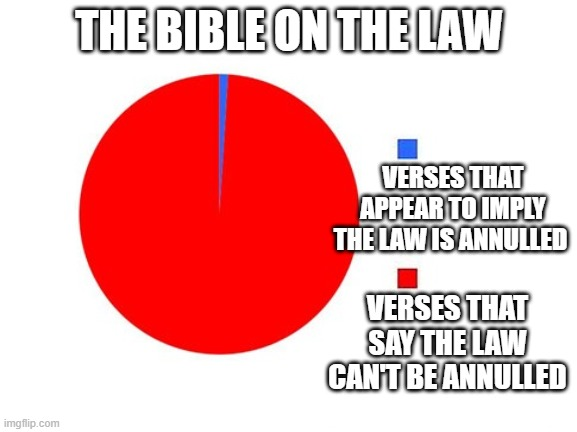
Pie chart comparing number of verses that appear to imply the law is annulled against verses that say the law can't be annulled.

I posted this image on X recently with the caption, ‘But I’m the one “cherry-picking” when I use the clear passages to interpret the ambiguous passages.’ After numerous hostile and rude replies, I added ‘I’d love to have a conversation with someone who disagrees and is intelligent, thoughtful, and civil. I’m tired of the frauds, snakes, and ignoramuses.’

Someone named Langston replied. His comments will be in quote blocks. Mine will be in bold.

Rom 6:14
for you are not under law but under grace.
Rom 3:21
now the righteousness of God apart from the law is revealed, being witnessed by the Law and the Prophets,
Rom 10:4
For Christ [is] the end of the law for righteousness to everyone who believes.

There’s much more

My reply reflected my irritation:

Are you volunteering for that conversation? Or just shotgunning prooftexts as if your interpretation is the only one possible?

Langston: My point is that the epistles are built upon the idea that the laws given to Israel have not come to us in the same form or fashion. It’s not just a couple obscure verses.
Due to the word limit, I wanted to lay a scriptural foundation from the outset.

Me: What do you believe it means for “sin to have no dominion over you” and how is this related to not being “under law” in Romans 6:14?

Langston: Sin, being made known by the law, has dominion over us, for by the law it brings us death and a curse. Yet we have become dead to the law and married to another, and therefore we are no longer under its dominion.

Me: That’s pretty much how I understand it too. We might still have a semantic difference in the word “dominion” or “under”, so let me tell you how I understand that concept, and you can let me know if you see it differently.

If a person is under law (in this case The Law), he is subject to the law’s power to condemn because he broke it. It doesn’t mean he has a legal obligation as a citizen to obey the law, but that his disobedience has given the law authority to punish him.

This is similar to idiomatic expressions like “running from the law”. That doesn’t mean that the legal code is chasing me. It means that the enforcers of the code are chasing me because I broke the code, putting me under the jurisdiction of the legal system. If I had not broken the law, the law would have no authority to come after me.

Since Jesus’ death expunged my criminal record, I have effectively died to the law, removing me from its authority to punish, but not my obligation as a subject of the King to keep the King’s Law.

To continue the analogy of human law, if a judge declared me innocent of criminal charges, that would release me from the authority of man’s legal system, but it would not absolve me from the obligation of every citizen to keep the law. If I despise the freedom that I have been given and continue to disregard the law, the judge will issue a new warrant for my arrest.

(The analogy isn’t perfect. I don’t think Jesus will reject anyone for sins of ignorance or weakness. I believe only our conscious rebellion will put us back under the dominion of sin, aka condemnation.)

Langston: we have been freed from the law and married to another, wouldn’t it follow that my obligation is to another as well?

So that is not to say we are without law, for we have come under the law of Christ.

Me: Absolutely. Our obligation is to Christ our King. We are under him, not under the Law. That doesn’t mean we don’t continue to obey his Law, though. It only means that our relationship to it has changed.

The Law is no longer our master. Where once it was a master to point us to our need for a Savior and also to keep us in bondage to our own sins until we submit to that Savior, now it has become a tool that the Holy Spirit can use to aid us in becoming more like him. The Law has become an advisor instead of an accuser.

Langston: the law was a tutor to bring us to Christ.

In high school I was obligated to comply with certain rules.

Upon graduation, though I can still appeal to the truths I learned, I’m not obligated to do all the things I was in HS.

I would say the same regarding Torah.

Me: I disagree.

There’s always a danger in taking an analogy too far, and Paul’s schoolmaster is a frequent victim.

Jesus said that anyone who relaxes even the least of the commandments in the Torah and teaches others to do the same will be called least in the Kingdom of Heaven, while those who do and teach them will be called great.

Paul and James said that every commandment that God gave can be summed up in the one: love your neighbor as yourself. John said that we only know that we love one another if we are keeping God’s commandments. This seems to me like a consistent doctrine of Jesus and the Apostles that the entire Torah remains God’s perfect standard for all people.

Obviously not all of it applies to everyone and there are some aspects that cannot be kept by anyone, but I can’t think of a single commandment that *can* be kept today that shouldn’t be. I can show how every single one of them shows love for both God and neighbor.

Langston: I don’t think the apostles are least in the kingdom for telling the gentiles that they only need to keep from idols and fornication. Nor is Mark for saying Jesus declared all food clean.

Again, we are freed from the Law.
I’m not under the law. I don’t have to make up an analogy.

Me: “I don’t think the apostles are least in the kingdom for telling the gentiles that they only need to keep from idols and fornication.”

I agree, but they didn’t tell them that. Paul also told them to refrain from lying, slave trading, “and whatever else is contrary to sound doctrine”.

I understand that you are referring to the Jerusalem Council in Acts 15, but I’m certain you don’t believe they were telling the Gentiles that they only needed to do those 4 things. I don’t think anyone believes that. Stealing, disrespect of parents, false prophecy, etc. are all still sins, but weren’t mentioned by the Council.

The controversy that the council addressed was concerning salvation and the immediate changes that must happen in order for anyone to be considered “saved”. As the Epistles clearly show, they never meant for anyone to think those were the only rules for Gentiles.

I address this in more detail in this article: Does Acts 15 Say We Can Ignore God’s Law?

And filled in some gaps in this one: Acts 15, revisited.

Langston: It’s those things unique to the laws of Moses.

“why do you test God by putting a yoke on the neck of the disciples which neither our fathers nor we were able to bear? But we believe that through the GRACE of the Lord Jesus Christ we shall be saved IN THE SAME MANNER AS THEY.”

Me: The “yoke…neither our fathers nor we were able to bear” isn’t the Law of Moses.

For this commandment that I command you today is not too hard for you, neither is it far off.
Deuteronomy 30:11 ESV

The unbearable yoke were the extra rules that the religious leaders had added to the Law.

They tie up heavy burdens, hard to bear, and lay them on people’s shoulders, but they themselves are not willing to move them with their finger.
Matthew 23:4 ESV

The scribes and Pharisees put that yoke on the people, not Moses. In Acts 15, those same people, although they had come to faith in Jesus, were trying to put all of the Gentile believers under the same bondage to man-made rules.

God’s Law is much simpler than man’s. Shortly after declaring that all who keep and teach even the smallest of God’s commandments in the Law of Moses will be called great in the Kingdom of Heaven, Jesus said,

“Take my yoke upon you, and learn from me, for I am gentle and lowly in heart, and you will find rest for your souls. For my yoke is easy, and my burden is light.”
Matthew 11:29-30 ESV

“Learn from me.” Learn what? Learn what he taught and what he did, and then do the same. Trust him.

Yes, we are saved in the exact same manner as everyone who came before the cross: by the grace of God. Nobody in any era of history was saved from their sins by obedience to the Law. The Law was given so that we would know what sin is, not so that we could be absolved from sins that we have already committed.

Langston: I’ll close here:

Verse 5: But some of the sect of the Pharisees who believed rose up, saying, “It is necessary to circumcise them, and to command them to keep the law of Moses.

Being yoked can just mean in subjection too. The fathers broke the laws. They didn’t handle the yoke.

Me: Agreed. That’s how Jesus used the term ‘yoke’, being in subjection to him. Being yoked isn’t necessarily a bad thing.

Acts 15:5 is a perfect illustration to prove my point. There is no command anywhere in Scripture to circumcise grown men as a condition for salvation or fellowship. Sure, if you want to eat a Passover sacrifice or go to the Temple, then you’d need to be circumcised, but neither of those circumstances were the issue. They were talking about Gentile converts who lived a long way from Jerusalem and were unlikely to ever have the opportunity to do either of those things.

Circumcision for salvation or even for membership in the commonwealth of Israel was a man-made invention, not a commandment from God.

I go into more detail on that here: The Covenants of Israel.

BTW, Langston, even if I disagree with you, I really do appreciate the civility and spirit of your conversation!

Langston: Much appreciated friend!

This conversation was such a refreshing break from the usual pattern on social media. Doctrinal disagreements don’t mean we have to be enemies.

A Twitter Exchange about “Torah-Keepers”

I saw this post on Twitter this morning from someone I will call GRD and felt obliged to respond. I thought the content was worth preserving here in the likely case that something will eventually happen to make it disappear from Twitter.

This is an image of the tweet to which I was responding…

Of course, I disagree with the original tweet about the Sabbath and with the person complaining about Torah-Keepers. Your eternal salvation is not contingent on the Sabbath and most Torah-Keepers do not engage in scare tactics to make you believe you need to keep the commandments “or else”. Most of us are simply trying to live the way God wants us to and some of us are trying to tell other people what God says about how to live.

Some people are all fire and brimstone and trying to scare people straight. Some people are obnoxious and legalistic and all kinds of other negative adjectives, but that’s true of every religion and denomination, not just Torah-Keepers.

So, here’s how the rest of this exchange went:

Me: If you’re open to an honest conversation between brothers with an aim to understanding instead of accusations, I’d love to talk about this topic.


GRD: That depends on: 1. Do you agree with [the OP’s] statement, “There is no salvation without the 7th day Sabbath!”? 2. Can you show me my accusations?


Me: 1. No 2. That was a proposal for a conversation, not an accusation in itself.


GRD: Start a thread. Tag me. Restrict comments to just you and me. Let’s see if it flies.


Me: I believe that Torah defines sin and is God’s standard of behavior for all people, so I’m one of those “Torah-Keepers” who believe in keeping the Sabbath.

I don’t believe that anyone can earn eternal salvation by keeping the Sabbath or any other commandment.

I don’t believe that Jesus or Paul taught people not to keep Torah (aka the Law of Moses). Their words–especially those of Paul–have been twisted and misunderstood to say what they never intended.


[Some confusion about Twitter notifications not working.]

GRD: In your original tweet, you said, ‘I believe that Torah defines sin and is God’s standard of behavior for all people, so I’m one of those “Torah-Keepers” who believe in keeping the Sabbath.’

So, do you believe that the Gentiles in Romans 2:12-16, who do not have the law, but do by nature the things contained in the law, showing the work of the law written in their hearts, keep the 7th-day Sabbath?


Me: No. Paul was talking about those aspects of the law that can be discerned by observing nature and following conscience. The concept of a sabbath could be derived from natural law, but God’s Sabbath could only be revealed by Him. The same is true of almost all of God’s Law. Let me give 2 examples.

1) The need for some kind of mediator between God and Man can be reasoned out from natural law, but the identity and nature of that Mediator can only be revealed supernaturally.
2) Open homosexuals (whom Paul had just condemned as sinners) often show that they are still able to discern some right from wrong when they defend their sin by appealing to monogamy and “committed relationships”. In that respect, they “do by nature things contained in the law, showing the work of the law written in their hearts”, but they are still disobedient in other respects.


GRD: I just discovered your reply and did not get notified of it. Maybe we should follow each other & send DMs when we reply? Missing notifications gets frustrating.

What’s your take on the scripture below, since Torah observers say the New Covenant is really a REnewed Covenant?


Me: Yeah, maybe following will kick the system. Some Torah-keepers say it is a “renewed” covenant, but I don’t think Scripture supports that. Jeremiah 31, 2 Corinthians 3, and Hebrews all say “new”, not “renewed”.

As Peter warned, Paul can be very difficult to understand. Without a thorough understanding of the Torah, he is impossible.

God’s Law had to be written down because the people couldn’t keep it through the spirit alone. Torah itself says that it is blessing if you keep it and a curse if you don’t. Of course, nobody is able to keep every commandment perfectly, so it becomes a ministration of death by it’s undeniable witness of sin. Most of it is very clear in meaning.

However, by faith, by God’s grace, and by Jesus’ death and resurrection, we are spared the eternal consequences of disobedience. The Law proves we are unworthy of eternal life and condemns us to death. God’s Grace forgives our sin, sets aside that condemnation, and promises eternal life. That doesn’t nullify the Law’s ability to define sin. It just takes away the Law’s power to condemn (ministry of condemnation).

As God reforms us in his image and writes his Law on our hearts, the written Law becomes less and less useful. I think the YLT is helpful here.

9 …for if the ministration of the condemnation is glory, much more doth the ministration of the righteousness abound in glory; 10 for also even that which hath been glorious, hath not been glorious—in this respect, because of the superior glory; 11 for if that which is being made useless is through glory, much more that which is remaining is in glory.

10-11 shows that the glory of the written Law that condemns has only diminished in comparison to the greater glory of the spiritual Law. As Jeremiah 31 says, the Law isn’t done away with; it’s only transferred from stone–which can ultimately only condemn because our hearts are unable to receive it–to hearts, where it can become part of who we are, not imposed from without, but natural and instinctive as reborn children of God.

[More confusion about Twitter notifications.]


At this point, GRD decided it wasn’t worth continuing since Twitter wasn’t notifying us when the other person replied. I wish we could have continued this conversation, as it seemed like we might have been able to reach some kind of understanding. In any case, I hope he was persuaded that manyTorah-Keepers are not legalist, salvation-by-works Judaizers.

The Law of God vs the Law of Moses

The Law of God vs the Law of Moses. A study on how the Torah applies to Christians.

There’s a growing dispensationalist belief among Christians that the Law of Moses is distinctly different from the Law of God and even that the Law of Moses is in some ways incompatible with the Law of God. I call this idea metanomianism, since I haven’t found another term for it.

The Law of Moses, in the metanomian view, is the rules that were given by God to the Israelites in Sinai through Moses. The Law of God is deeper principles that aren’t necessarily written down anywhere, but are reflected in aspects of the Law of Moses, as well as the teachings and lives of other Biblical figures, such as Abraham and David.

Accordingly–again, in the metanomian view–the Law of God finds its most explicit treatment in the Sermon on the Mount and the epistles of Paul. Even so, it’s really impossible to express the Law of God in words with any real precision, because it’s too big and too deep to be neatly defined and boxed up by the human mind.

At first glance, that doesn’t seem too far off. The Law of Moses really doesn’t define every possible wrong and right. It was written to encourage people to take what is written and apply it to situations that aren’t directly addressed. That’s even more true today. They didn’t have computers and cars in the Bronze Age, so there are things that we have to think about today that never would have crossed Moses’ mind. Likewise, they had to worry about things that very few people today will ever encounter.

The instructions that God gave to the ancient Israelites in the wilderness were tailored to that time and place. If the Exodus and the wilderness wandering happened today, Moses might have given some instruction on traffic control and digital rights management. Our job is to extrapolate modern application from God’s ancient instructions.

Unfortunately, that’s not really what metanomian teachers mean when they say that God’s Law is different than the Mosaic Law. The devil is in the details, as they say.

Notice that the first paragraph at the top of the article includes the phrases “distinctly different” and “aspects of the Law of Moses”. That’s because metanomians believe that only parts of the Law of Moses are derived from the eternal and immutable Law of God and the rest consists of temporary measures added just to keep Israel separate from other nations or as object lessons about human frailty and substitutionary atonement. Some requirements of the Mosaic Law might actually be contrary to the Law of God and only given as corrective measures for temporary problems, like stealing from someone in order to teach them that stealing is wrong.

According to metanomian doctrine none of the Law of Moses applies to a Gentile Christian. Not the dietary laws, not the sacrifices, not the sexual morals, and not even the Ten Commandments. None of it applies. We are under a different law now, sometimes called the Law of Christ, Law of the Spirit, or Law of Life.

There are some variations on metanomianism, as there are with all doctrines.

Some metanomians will say that the Mosaic Law still applies to Jews, while others insist it doesn’t apply to anyone anymore. Some people will insist that the Ten Commandments apply (except for the Sabbath, for whatever reason). Others will say the “moral” laws apply while the “ceremonial” laws don’t. Dividing the law into moral, ceremonial, and civil is an invention of men, though, and if a person is rigorously consistent in their doctrine, he will have to throw it all out or none of it.

This allows a metanomian theologian to say that New Testament passages encouraging believers to keep God’s Law aren’t talking about the Law of Moses, but the Law of Christ or the Law of the Spirit or whatever other term they choose to substitute. When John writes that “sin is transgression of the law”, he’s not talking about the Law of Moses, but God’s Law, which was never fully written down.

Metanomianism says that any resemblance between this law and that of Moses is due to their common source in God, not to their actually being the same law. We are not to commit murder because James said not to, not because God told Moses “Thou shalt not murder”. We are not to be sexually immoral because Paul said so, not Moses.

Read the following verses from a metanomian perspective and you can see how a Christian might completely reject the Law of Moses and still believe that he’s keeping God’s Law:

If you keep my commandments, you will abide in my love, just as I have kept my Father’s commandments and abide in his love.
John 15:10 ESV

For this is the love of God, that we keep his commandments. And his commandments are not burdensome.
1 John 5:3 ESV

Then the dragon became furious with the woman and went off to make war on the rest of her offspring, on those who keep the commandments of God and hold to the testimony of Jesus. And he stood on the sand of the sea.
Revelation 12:17 ESV

But there are three very big problems with this idea.

The first problem is that the Bible itself equates the Law of Moses with the Law of God.

Not only the Bible, but Jewish literature of the Second Temple Period, and writers of the early Church all consistently refer to the Law of Moses as the Law of God or the Law of the Lord. This makes it very unlikely that the Apostles had anything other than the Torah (the first five books of the Bible) in mind when they wrote of the Law of God.

Let me give you some examples from all three categories:

The Old Testament

  • Joshua 24:6 describes how Joshua completed the book of Deuteronomy, calling it “the book of the Law of God”.
  • 1 Chronicles 16:40 references the sacrificial laws of Leviticus contained in “the Law of YHWH”.
  • 2 Chronicles 17:9 mentions the “book of the Law of YHWH”, from which a team of Levites taught the people of Judah. There is no question that this refers to the Law of Moses.
  • 2 Chronicles 31:4 refers to tithes and portions of offerings due to the Levites as specified in “the Law of YHWH”. Those instructions are in Leviticus and Numbers, the Law of Moses.
  • Nehemiah 8-9 describes how the Levites read from the books of “the Law of God” and “the Law of YHWH” in a clear reference to the written Law of Moses.

The Deuterocanon and Apocrypha

  • 1 Maccabees 2:26 says that Mattathias was zealous for the “Law of God” when he objected to the Syrians defiling the altar, forcing Jews to eat pork, and forbidding circumcision.
  • The Testament of Levi 9 says that Isaac taught to Levi the “Law of the Lord”, including the entire sacrificial system. In 13:2-3, Levi encourages teaching children to read the “Law of God” because knowing the “Law of the Lord” brings honor. You can’t read an unwritten law.
  • Tobit 1:3 says that the feasts of ascent detailed in Exodus, Leviticus, and Numbers are in “the Law of the Lord for Israel”.

The Early Church

  • In his Homilies on the Gospel and First Epistle of John, St. Augustine repeatedly calls the written commandments the “Law of God”.
  • In Against Heresies, Irenaeus paraphrased Yeshua from Matthew 15:6 to say “Why do you make void the Law of God by reason of your tradition?” The specific commandment in the original statement is “Honor your Father and your Mother” from Exodus 20:12. Irenaeus repeatedly equates the Mosaic Law to the Law of God or the Law of the Lord.

Of course, many of the church fathers completely rejected the Law of Moses and said that God had replaced it with a new law–Marcion is the most infamous of them–but this shows that they still recognized the Mosaic Law as God’s Law and not something separate. Others might have believed this same idea that the Law of Moses wasn’t really the Law of God, but Augustine’s writings show that this wasn’t the predominant view even centuries later.

The second problem is that metanomianism logically excludes all of the teachings of Yeshua from the New Law.

Of course, most proponents of metanomianism haven’t thought it through that far, but I’d like you to consider that Yeshua preached only to Jews who were “under the Old Covenant”, explicitly excluding non-Israelites from his teachings. “I was sent only to the lost sheep of the house of Israel.” (Matthew 15:24)

Any moral instruction he gave to the Jews before the Cross is only strictly applicable under the administration of the Law of Moses. All forms of dispensationalism teach that Yeshua was under a different Covenant and a different Law. The only moral instruction in the Bible that directly applies to a Christian today, according to metanomianism, is that given by the Apostles after Acts 1. Any moral instruction before that point only applies in so much as it reflects a greater principle within the unwritten Law of God.

The third major problem with metanomianism is that it makes sin undefinable.

In Romans 7:7, Paul says that he wouldn’t have known what sin was if the Law of Moses didn’t tell him. Once he knew the Law, he became responsible for obeying it and failing (committing sin) incurred condemnation. In 1 Corinthians 15:56 he repeats the essence of this argument when he says that “the power of sin is the law”, seemingly reiterating the Law of Moses as the authority which defines sin. Throughout his letters, he based teaching after teaching on specific statutes and ordinances from the Torah.

James, in chapter 2 of his letter, quotes Leviticus 19:18 as the “royal law” and says that if we violate Deuteronomy 16:19, we “are committing sin and are convicted by the law as transgressors.”

In his first letter, John writes that “Everyone who makes a practice of sinning also practices lawlessness; sin is [by definition] lawlessness.” (1 John 3:4) If the law that sinners are breaking is not the written commandments of Torah, how are we to know if we are sinning or not? Certainly the Holy Spirit convicts each of us of wrongdoing and urges us to repent, but that is part of an individual relationship, not an objective standard by which we can advise each other as the Apostles instructed.

Some of the moral teachings of Yeshua and the Apostles were based on the stories of the patriarchs in Genesis or on the prophets, but the majority were explicitly derived from the instructions of Moses. If Peter and James and John and Paul–who said “imitate me as I imitate Christ”–based their moral instruction on the Law of Moses, which was called “the Law of God” in the only Scriptures they knew, on what basis can a person today presume to say that he knows better and that the Law of Moses is not the Law of God and has nothing to do with today’s Christian?

Logically and Scripturally Untenable

These three problems make the whole doctrine of metanomianism logically and scripturally untenable. The only “Law of God” that the Tanakh (what we now call the Old Testament) appears to know is the law given through Moses. Some will point out that Genesis says that Abraham kept God’s Law, and they are correct. However, Genesis 26:5 actually says that Abraham kept God’s “charge, commandments, statutes, and laws”, which implies detailed instructions, not a vague set of principles. Second Temple Jewish literature, such as The Testament of Levi, which was also popular among Christians, shows that the Jews of the Apostles’ day believed those “commandments, statutes, and laws” were exactly the same as those given to Moses at Sinai.

The Apostles didn’t have the New Testament. They only had the Tanakh and other Jewish writings of the day. Moral teaching given by the Apostles was derived from the Law of Moses. Paul said “imitate me as I imitate Christ”, yet Christ (aka Jesus or Yeshua) obeyed every particular of the Law of Moses and spent his entire ministry teaching others how to do the same.

What sense does it make for Yeshua and his Apostles to base their teachings on a Law that has been thrown out in favor of a better one? Of course, it will be argued by some metanomians that they were only using passages from the Law of Moses to illustrate moral concepts that transcend Moses, but why didn’t they ever say that? Why wouldn’t such an important idea ever be explicitly spelled out by anyone?

The closest that anything in the Bible comes to saying that the Law of Moses is not the Law of God is Hebrews 7-8, which only speaks of how different priesthoods operate under different sets of rules for different purposes, but that is in perfect alignment with Moses, and explicitly states in 8:13 that the Old Covenant had not yet passed away at the time the letter was written. (See Priests, Laws, and Covenants in Hebrews 7-8 for a more detailed treatment.)

A consistent application of this division will inevitably lead to something very much like Marcionism. You will eventually have to throw out the 90% of the New Testament that consists of commentary on the Mosaic Law. Just look at Andy Stanley and his comments in recent years about “unhitching” our faith from the Old Testament and how open and unrepentant homosexuals who still go to church have more faith than other Christians who are have not rejected God’s instructions on sex.

True Christians Keep the Law of Moses No Matter What They Believe About it

Fortunately, a Christian who legitimately fears God and wants to be a disciple of Yeshua will still end up keeping almost the entirety of the Law of Moses anyway, despite holding to the false doctrine of metanomianism, because the Holy Spirit will lead him there. Some sins are more deeply embedded in our psyches and spirits than others, but every Christian will be convicted to repent of the most egregious sins against God and neighbor. Whether they choose to follow that conviction or not will determine whether they stand with Joshua who said “Choose this day whom you will serve, but as for me and my house, we will serve YHWH”, or with Andy Stanley who is rushing down the road of throwing out the entire Bible.

As I noted above, I agree that the Law of Moses is not exactly the same thing as the Law of God, but only in the sense that traffic laws are not the same as whole body of laws and regulations of your city, state, and nation. The entire Law of Moses is the Law of God and nothing in it is contrary to anything in the Apostolic teachings. Every single commandment given at Sinai and in the Wilderness is instruction in how to love God and man, and is therefore 100% compatible and consistent with the Law of God.

John said that we can be sure we are loving each other if we are keeping the commandments of God, and Paul said that every commandment of Moses can be summed up in a single phrase: “Love your neighbor as yourself”. Yeshua said, “If you love me, you will keep my commandments.” If you believe that Yeshua and the Father are one, as he said, then Yeshua’s commandments are the Father’s commandments that were given to Moses.

An honest and consistent reading of the entire Bible–instead of cherry-picked verses taken out of context–allows no other conclusion: The Law of Moses is the Law of God.

Yom Kippur – The Most Christian of God’s Moedim

Yom Kippur is the most Christian of God's appointed times

A guest post by Kay Behrens

As I was sitting in my Living Room ten days ago, honoring one of God’s Moedim, or Set Apart Days, I came to the realization that Yom Kippur, or the Day of Atonement, is the most “Christian” of God’s Holy Convocations. But, what do I mean by that?

Let’s look at God’s Set Apart Days, one by one. We can begin with Passover.

Passover ~ On Passover, God instructs us to do several things, besides our offerings. We are to cook the lamb, to remove leaven from our homes, to prepare the bitter herbs.

Unleavened Bread ~ Here we are to eat the meal, but most important of all, we are to tell our children the story of the Exodus. They are to be active participants of the evening.

First Fruits ~ Here we are to offer the first fruits of our harvest.

Shavuout ~ Fifty days after the early First Fruits, we are to have a Holy Convocation and to offer two loaves of leavened bread, a later first fruits.

Yom Teruah ~ The Day of Trumpets. On this day we are to blow the trumpets and shout for joy to the Lord.

Sukkot ~ Here we are to build and live in Booths for 7 days. We are to wave the four species. We are to remember our days in the desert.

But what of Yom Kippur? How are we to spend that day? Doing nothing.

And any person who does any work on that same day, that person I will destroy from among this people. You shall do no manner of work; it shall be a statute forever throughout your generations in all your dwellings. It shall be to you a Sabbath of solemn rest, and you shall afflict your souls; on the ninth day of the month at evening, from evening to evening, you shall celebrate your Sabbath.
Leviticus 23:30-32. 

But why do I say that this is this a “Christian” moedim? Well, let’s look at the Christian understanding of salvation, or atonement. Christians teach that we are not saved by works, but by grace and grace alone. They are taught that “works salvation” as taught in the Old Testament no longer applies and that we cannot save ourselves by our works but only by resting on the completed work of Messiah.

Have you ever spent 24 hours where you can do no work? It truly concentrates the mind. Add to that a fast from food and water and you definitely start paying attention. Get up and take a shower? Nope. Make your bed (probably not a problem for most millennials, but it sure bothers me); fill or empty the dishwasher? Later. Check the internet? Your phone? Your tablet? Not today. Squash that fly? Dust off that spider’s web? Wipe down the counter? Nope, nope, and nope. Read a book, send a note to a friend, start that craft project?  Can’t do.

Your day is to be completely about resting in the Lord. He is your salvation, your atonement, even your bread of life if you are fasting.

Ah, but you say that “Messiah died once for all and He sat down at the right hand of God and for us to keep the Old Testament feasts is to put Him back on the cross to suffer once again”. To this I would say that, yes, Messiah sacrificed once and then sat at the right hand of the Father, but we are not called to remember this once and only once. We are to be reminded yearly of His sacrifice. I liken this to a married couple who keep their vows daily, but once a year takes the time to recognize the special bond that they have. If they don’t take this time to lovingly recall their commitment they might begin to take it for granted. Likewise, if we don’t take the time to recall the sacrifice of our Messiah, we will begin to take it for granted.

So how shall we remember His sacrifice? Certainly by keeping the Passover, or by the remembrance of Good Friday and First Fruits, but Yom Kippur forces us to really remember the totality of His gift to us. On Yom Kippur, we are to completely separate ourselves from the world; we are to completely rely on His provision. We do not work, we do not eat, we do not rely on anyone or anything but our Messiah.

We cannot make the day of Yom Kippur any more holy by doing anything beyond “afflicting your souls” and having “a holy convocation”.

So I invite my dear Christian friends to consider next year keeping Yom Kippur, the Day of Atonement. Try spending a day completely without works. Spend a day in your Living Room without swatting that fly, without squashing that spider, without doing anything. Spend it with the Scriptures that attest to our Lord who gave His life so that we may live. Who is the Bread of Life and the True Vine.

What Is Circumcision of the Heart?

Circumcise therefore the foreskin of your heart, and be no longer stubborn. Deuteronomy 10:16

Circumcise therefore the foreskin of your heart, and be no longer stubborn.
Deuteronomy 10:16

Circumcise yourselves to YHWH; remove the foreskin of your hearts, O men of Judah and inhabitants of Jerusalem; lest my wrath go forth like fire, and burn with none to quench it, because of the evil of your deeds.
Jeremiah 4:4

But a Jew is one inwardly, and circumcision is a matter of the heart, by the Spirit, not by the letter. His praise is not from man but from God.
Romans 2:29

(Please read the whole chapter for each of those verses to understand the full context. Click on each reference to access the chapters at Bible Gateway.)

But Paul Said…

Paul is often misunderstood to be against physical circumcision in all cases, but the full context of his letters show that can’t be the case. Rather, he is against circumcision in a misguided conversion to Judaism or the performance of any other rite or commandment as a condition for the forgiveness of sins and eternal salvation.

Salvation is solely by the grace of God extended to those who put their faith in him. Circumcision is something that a believing man can do later if he is led to it by the Holy Spirit or if there is some practical reason, so long as he doesn’t believe it will make him more saved. There is no general command in Scripture for a grown man to be circumcised unless he is wants to eat the Passover, which is impossible to do outside of Jerusalem. Anyone external pressure for a grown man to be circumcised comes solely from other men, not from God.

If you’re not a priest going to serve in the Temple (you’re not), if you’re not going to eat a Passover lamb this year (extremely unlikely), and if you’re not an 8-day old baby boy (wow! reading already!?) then there is no good reason to get circumcised.

Now, having dispensed of that inevitable barrier to communication, let me get the actual point of this article…

What Does It Mean to Circumcise One’s Heart?

In Deuteronomy 10, Moses told the Israelites that, although God owns all of heaven and earth, he chose Abraham, Isaac, and Jacob and all their descendants as special objects of his love and attention. Because God chose Israel above all other peoples, he wanted them to circumcise the foreskin of their hearts “and stop being stiff-necked”.

He went on to say that God is mighty and awesome, above all other gods, and above all the petty bribery that the gods of the nations demanded from them. Yet, despite his awesome power and the universal scope of his awareness, he gives special attention to orphans, widows, and landless above the special attention he already gives to Israel.

Love the sojourner, therefore, for you were sojourners in the land of Egypt.
Deuteronomy 10:19

The essence of heart circumcision seems to be in the humility to accept the attentions of the Almighty and to serve those who have the least power of all.

Because of Adam’s sin, our world can be hard and compassionless. It’s tempting to see all impoverished or otherwise disadvantaged people as deserving their state–an attitude encouraged by some of the world’s largest religions–and therefore also deserving lesser treatment by society and even by law.

While it’s true that poverty is perpetuated by bad choices, Scripture also tells us that we are all sinners according to God’s standards and equally deserving of death. A circumcised heart perceives its own unworthiness, but gratefully accepts and returns God’s love in spite of that. It not only loves God, who is infinitely more deserving, but also loves the poor, homeless, and even the criminal.

God wants us, who have received undeserved mercy, to extend undeserved mercy in turn, a mercy which enables the recipient to stand back up and try again and again to make better choices.

Be Holy, Even As I Am Holy

God wants us to be holy (set apart for sacred purpose) just as he is holy. In Leviticus chapters 11, 19, and 20, this means keeping God’s commandments, especially in regards to avoiding the pagan practices of idolatry, necromancy, disrespecting parents, sexual immorality, and eating animals whose meat God finds detestable.

Peter reiterated this expectation of holiness through obedience:

As obedient children, do not be conformed to the passions of your former ignorance, but as he who called you is holy, you also be holy in all your conduct, since it is written, “You shall be holy, for I am holy.”
1 Peter 1:14-16

It’s clearly a good thing to keep God’s commandments, and while outward obedience will bring circumcision of the flesh (at least for boys born into the faith), it cannot, by itself, bring circumcision of the heart.

The truth is exactly the opposite. A hard heart is like a hardened clay soil that breaks ploughs and starves seedlings. The Word sprouts quickly but withers away because it can’t put down roots. It is a haven for brambles and wild grass, but hostile to anything that can produce good fruit. Only a circumcised heart can accept the seed of God’s instructions and allow it to produce a harvest worthy of the land owner.

So, if a man who is uncircumcised keeps the precepts of the law, will not his uncircumcision [of the flesh] be regarded as circumcision [of the heart]? Then he who is physically uncircumcised but keeps the law will condemn you who have the written code and circumcision but break the law.
Romans 2:26-27

The Hearts of Your Children

There is another important aspect of heart circumcision that I want to bring to your attention.

The manner of circumcision of the flesh was not arbitrary. God chose the skin that would be cut removed in part because it symbolizes one of the core promises of his covenant with Abraham:

And I will establish my covenant between me and you and your offspring after you throughout their generations for an everlasting covenant, to be God to you and to your offspring after you….This is my covenant, which you shall keep, between me and you and your offspring after you: Every male among you shall be circumcised. You shall be circumcised in the flesh of your foreskins, and it shall be a sign of the covenant between me and you.
Genesis 17:7, 10-11

Abraham’s physical descendants all passed through the cut of his physical circumcision. All of his promised descendants inherit the covenant by which they were promised, but they are commanded to circumcise their sons in turn.

If you are a son of Abraham, then your sons must be circumcised on the eighth day. This doesn’t give them eternal salvation or forgive their sins, but it does make God’s promises to Abraham theirs to reject.

Circumcision of the heart follows the same pattern as circumcision of the flesh.

And YHWH your God will circumcise your heart and the heart of your offspring, so that you will love YHWH your God with all your heart and with all your soul, that you may live.
Deuteronomy 30:6

Just as Moses told us to keep God’s commandments as we work to circumcise our hearts, he also told us to teach God’s commandments to our children.

And these words that I command you today shall be on your heart. You shall teach them diligently to your children, and shall talk of them when you sit in your house, and when you walk by the way, and when you lie down, and when you rise.
Deuteronomy 6:6-7

Circumcision of the heart is a process that each person must take on for himself, but parents have a responsibility to set their children on the right path, to teach them to fear and love YHWH, to cherish his commandments, and to be kind to all people. In doing so, we enable them to inherit the New Covenant established in the blood of Yeshua.

How Does a Heart Become Circumcised?

Physical circumcision is relatively quick and painless. We circumcise our sons when they are eight days old, before they are old enough to remember the pain. Circumcision of the heart is a much longer and more painful process. It begins and ends with obedience, not for the sake of being righteous or special or staying out of trouble, but for the sake of the Law-Giver.

And now, Israel, what does YHWH your God require of you, but to fear YHWH your God, to walk in all his ways, to love him, to serve YHWH your God with all your heart and with all your soul,
Deuteronomy 10:12

And this is love, that we walk according to his commandments; this is the commandment, just as you have heard from the beginning, so that you should walk in it.
2 John 1:6

God wants our fearful devotion and our love. He wants to be the center of our thoughts, motives, and our entire lives. Such devotion requires the breaking of our pride, our independence, and even our very identity.

If a commandment is a burden, then it either hasn’t yet done its work on your heart, or you are keeping it for the wrong reason. A resentful or prideful obedience is not obedience at all. Refocus on the loving kindness of the Father who gave us the Law through Moses, of the Son who gave us his very life to enable our obedience without fear of condemnation, and of the Spirit who teaches us how to live, comforts us when we fail or are persecuted for our obedience, and guides us onto better paths.

As we learn to keep God’s commandments out of love for him, his Spirit works through our desire to obey to draw us closer to him. Through the keeping of commandments with a right heart, we are disciplined and pruned. The heart will become more right, and we will learn more perfect obedience, understanding that the heart of every commandment is love.

The secret to a circumcised heart, ready to receive God’s instructions, is in recognizing that we are no more deserving of his attention than anyone else, that nothing we could ever do could earn his affections, and yet God still loves us more than all the rest of creation. When we love him enough in return to submit to his commandments and when we see a reflection of his perfection and our own failures in the least of all people, we will be on the path.


For more information see this video from 119 Ministries…

Is the New Covenant in Force?

Is the New Covenant fully in force today? Since Jeremiah says it is only for Israel and Jews, what does it mean for Christians?

In that same ancient Internet forum that I have mentioned several times before, a Torah-keeping believer wrote, “Until the Law is written on our hearts, it is still needed. And, since Christians are NOT keeping the Law, it is obvious that it hasn’t been written there. Therefore, the New Covenant has not yet come, even though it has been promised and assured.”

Another forum-member, whom we will call Joe, ever the Christian example, responded,

The new covenant has come, you blithering idiot!

That’s entire ——– point of Jesus’s life ministry, death, and resurrection!

He brought the new covenant. He tore the veil in the temple. He saved us from sin and death. He rescued us.

Joe’s objection is a very common one and also very easy to answer. It’s not even entirely wrong. Jesus (aka Yeshua) did save us from sin. He rescued us from the condemnation that we justly deserved due to our lawlessness. But the New Covenant is more than that. The ubiquity of this confusion testifies to the widespread ignorance of Christians concerning scripture and their almost complete reliance on the doctrines of men rather than the actual words of God and the prophets.

What Is the New Covenant?

Here is the passage that most specifically promises the New Covenant:

Behold, the days are coming, declares YHWH, when I will make a new covenant with the house of Israel and the house of Judah, not like the covenant that I made with their fathers on the day when I took them by the hand to bring them out of the land of Egypt, my covenant that they broke, though I was their husband, declares YHWH. For this is the covenant that I will make with the house of Israel after those days, declares YHWH: I will put my law within them, and I will write it on their hearts. And I will be their God, and they shall be my people. And no longer shall each one teach his neighbor and each his brother, saying, ‘Know YHWH,’ for they shall all know me, from the least of them to the greatest, declares YHWH. For I will forgive their iniquity, and I will remember their sin no more. Thus says YHWH, who gives the sun for light by day and the fixed order of the moon and the stars for light by night, who stirs up the sea so that its waves roar— YHWH of hosts is his name: If this fixed order departs from before me, declares YHWH, then shall the offspring of Israel cease from being a nation before me forever. Thus says YHWH: If the heavens above can be measured, and the foundations of the earth below can be explored, then I will cast off all the offspring of Israel for all that they have done, declares YHWH. Behold, the days are coming, declares YHWH, when the city shall be rebuilt for YHWH from the Tower of Hananel to the Corner Gate. And the measuring line shall go out farther, straight to the hill Gareb, and shall then turn to Goah. The whole valley of the dead bodies and the ashes, and all the fields as far as the brook Kidron, to the corner of the Horse Gate toward the east, shall be sacred to YHWH. It shall not be plucked up or overthrown anymore forever.
Jeremiah 31:31-40

These are the defining characteristics of the New Covenant:

  1. The covenant is with the houses of Israel and Judah.
  2. The Law will be written in the hearts of the Israelites and Jews.
  3. Israelites and Jews will not need to be taught about God because they will all know him intimately.
  4. The sins of Israelites and Jews will be completely forgiven.
  5. God will never completely reject the nation of Israel, including the Jews.
  6. Jerusalem will be restored and made sacred to God under a permanent peace.

These characteristics imply other things. Since all Jews will know God and since they were intended to be a nation of priests and a light to the rest of the world, those who would know God will go to the Jews as evidenced by Jeremiah 16:19 and Zechariah 8:23.

What Does the New Covenant Have to Do with Gentiles?

O YHWH, my strength and my stronghold, my refuge in the day of trouble, to you shall the nations come from the ends of the earth and say: Our fathers have inherited nothing but lies, worthless things in which there is no profit.
Jeremiah 16:19

Thus says YHWH of hosts: In those days ten men from the nations of every tongue shall take hold of the robe of a Jew, saying, ‘Let us go with you, for we have heard that God is with you.’
Zechariah 8:23

From the examples of Torah, from these prophecies, and from Paul’s writings, we can also extrapolate that the promises of the New Covenant and citizenship in Israel would be extended to gentiles. That doesn’t change the nature of the covenant, only its breadth. This is the great inheritance we have gained through the Messiah. We are now joint heirs with Israel in the New Covenant. We have forgiveness of sins just like the Jews do.

Guaranteed, but Not Yet Delivered

But has God’s Law been written on our hearts? Do we no longer have to teach each other about God? Is Jerusalem free from danger? Obviously to all but the most delusional, Jerusalem is under constant threat of war. We do not have God’s Law written on our hearts. We still have to teach each other about God. Paul wrote that this great inheritance of a perfect knowledge of God isn’t yet ours. I believe that process begins at the moment we decide to be faithful to Yeshua, but it is clearly not remotely complete.

In him you also, when you heard the word of truth, the gospel of your salvation, and believed in him, were sealed with the promised Holy Spirit, who is the guarantee of our inheritance until we acquire possession of it, to the praise of his glory.
Ephesians 1:13-14

He who has prepared us for this very thing is God, who has given us the Spirit as a guarantee.
2 Corinthians 5:5

There are several steps in selling a house that are exactly analogous to the New Covenant. We have a signed contract, which is God’s promise of salvation. We have an earnest of the eventual fulfillment of the contract in the form of the Holy Spirit. But the terms of the contract haven’t been completed yet. Yeshua has paid the ultimate price for our salvation and restoration to the Father, but until we shed our mortal “tents”, we still walk by faith in the promise of our salvation and in imperfect knowledge of the Father. When we have the New Covenant in full, we will no longer have to walk by faith alone because we will see him face to face.

The Letter to the Hebrews (8:13), written many decades after Yeshua ascended to Heaven, speaks of the New Covenant as a developing thing, slowly outshining the Old Covenant, like the rising sun that makes the stars fade away. But at the time of the writing of that letter, the Old was still “becoming obsolete” and was only “ready to vanish away”. That which has been guaranteed and secured with an earnest payment has not yet been delivered. That which is still waxing, is not yet fully risen.

The New Covenant was certain and began to be established from the moment it was first prophesied in the Garden of Eden. It was sealed by blood at Yeshua’s crucifixion and a great token of its inevitability was given to us at Pentecost, but it is not yet fully in force as God promised it would be. Like so many things prophesied in Scripture, the New Covenant is “already, but not yet”.

Acts 15, revisited

Are Christians obligated to keep the Law of Moses? Should Christians study the Torah?

People frequently point to Acts 15 and the Council of Jerusalem as an argument against Christians keeping Torah. “Peter, James, and the other Apostles said that gentile converts only need to keep these four rules, so we don’t need to keep the Law of Moses.” The obvious counter is that, if eating food that has been sacrificed to idols, sexual immorality, eating animals that have been strangled, and consuming blood (Acts 15:20) is the full moral standard for Christians, then we are free to dishonor our parents, thumb our nose at traffic signs, lie, cheat, steal, and curse God. Yet nobody believes that!

Clearly the ruling of the Jerusalem Council is just a baseline for new converts in the context of the pagan Roman Empire, who already had a basic understanding of right and wrong.

Here’s another statement extracted from a conversation from a long time ago, in an Internet forum far, far away:

Jesus’ entire ministry on earth was centered around clarifying the law, and in many places he criticizes those who live by the letter of the law instead of the spirit of the law. an example is the “good samaritan parable”. The laws were given to the Jews in order to keep them ceremoniously clean and set aside for God. So when Jesus says that he did not come to abolish the law, but to fulfill it, his blood sacrifice has fulfilled the spirit of the law by making us clean before God and setting us aside for him. I believe as much is stated in John 1:1-14.

I do not believe that Acts 15 is suggesting that Christians can lie, steal, etc. etc., because such things were not included in the letter. Rather I believe that as Jesus said, the sum of the laws and the prophets, the spirit of them, is to love the Lord you God will all your heart, and your neighbor as yourself.

-Mr. B.A.D.

I don’t think that Mr. B.A.D. is very far from the truth here. Yeshua did spend much of his time correcting misunderstandings of the Law. God did give the Torah to Israel to set them apart from other peoples. Yeshua’s life and sacrifice did fulfill the spirit of the Law. The sum of the Law and the Prophets is to love God and neighbor.

But this is an incomplete understanding. Let’s look at each of these points in more detail.

Yeshua criticized those who live by the letter of the law instead of the spirit of the law.

Mr. B.A.D. is talking about the Pharisees in particular, I think. Here are some of the specific complaints Yeshua had against them:

  1. They replaced the commandments of God with the commandments of men. (Matthew 15:9)
  2. They held others to a higher standard than that to which they held themselves. (Matthew 23:4)
  3. Their obedience was done mostly for show and not out of love for anyone but themselves. (Matthew 23:5-7)
  4. Their false teachings made it more difficult for anyone else to know the truth. (Matthew 23:13)
  5. They abused the poor and weak. (Matthew 23:14)
  6. They didn’t make disciples for God, but disciples for themselves. (Matthew 23:15)
  7. They had their priorities all wrong. (Matthew 23:16-22)
  8. They were scrupulous on the minutiae of the Law while they ignored the most important commandments. (Matthew 23:23-24)
  9. Their public behavior was at complete odds with their private behavior and with their hearts. (Matthew 23:25-31)

It seems to me that all of this can be summed up in a single word: hypocrisy. Their problem wasn’t that they were obsessed with the letter of the Law. Their problem was an obsessions with appearing to keep the Law. They were so concerned with this appearance that the Law itself wasn’t enough for them. “Love your neighbor as yourself” isn’t showy enough for the Pharisaical mind. They had to make up more and more rules to follow so that everyone could see how very righteous they were, but in adding to God’s Law they were breaking the very thing they pretended to keep. They were hypocrites from their white-washed facades to their rotted cores.

I think Mr B.A.D.’s main point here is entirely correct. A preoccupation with the letter of the Law to the detriment of the spirit of the Law will destroy you, because it will tend to lead you to less obedience in the end, rather than more. It is easy to get lost in the details and forget what is most important. The individual commandments are not the goal, but only individual stones in the road. The goal is Yeshua, and we would all do well to keep our focus on him rather than on precisely measuring our tithes of mint and cumin.

The laws were given to the Jews in order to keep them ceremonially clean, and set aside for God.

The Law was given for many reasons, one of which was to keep the Israelites separate from the pagan nations around them, but this separateness is really more of an effect of the Law than an intent. God gave Israel the Law to teach them to behave better than the Canaanites, not just differently. The specific commandments weren’t arbitrary. God didn’t randomly pick which animals would be clean and unclean, or which fabrics they could and couldn’t mix.

Israel is a holy nation because God chose them from among all other nations to be his special possession. Holiness means “set apart for divine purpose”. Since he made them holy by election, he also wanted them to be holy by behavior. The goal of behaving differently isn’t just to stand out. The Pharisees were great at standing out from the crowd, but terrible at obeying God’s Law. Rather, the goal of God’s rules about behaving differently than the pagans, was to make Israel more beautiful and pleasing to him.

Why should Israel not eat pigs? Because eating pigs is detestable to God. Why should Israel not wear clothes made of wool and linen woven together? Because, whether we understand why or not, God hates it.

But that’s not the only reason God gave Israel the Law.

Paul wrote that the Law was also given to define sin for the whole world (Romans 3:19-20).

Now we know that whatever the law says it speaks to those who are under the law, so that every mouth may be stopped, and the whole world may be held accountable to God. For by works of the law no human being will be justified in his sight, since through the law comes knowledge of sin.
Romans 3:19-20

The whole world–not only the Jews–is accountable to God for their disobedience to the Law. As John wrote, sin is lawlessness, and he didn’t mean the laws of Rome or Babylon. He meant God’s Law. Sin is, by definition, breaking God’s Law. Now that we are saved from condemnation and our sins have been forgiven, are we supposed to forget what sin is and behave in whatever manner we feel is right? Of course not! God’s forgiveness of past sins is not a license to commit future sins.

Do we then overthrow the law by this faith? By no means! On the contrary, we uphold the law.
Romans 3:31

Now that we have been separated from the world, elevated to the status of a holy people along with the native-born Israelite, we demonstrate our gratefulness and maintain that separation by behaving differently than we behaved when we were still in sin. “Be holy, even as I am holy” in 1 Peter 1:16 is a quote from multiple passages in Leviticus. We have been made holy by divine action, and so God requires us to live accordingly by following the rules he gave for that purpose.

Do not be unequally yoked with unbelievers. For what partnership has righteousness with lawlessness? Or what fellowship has light with darkness? What accord has Christ with Belial? Or what portion does a believer share with an unbeliever? What agreement has the temple of God with idols? For we are the temple of the living God; as God said, “I will make my dwelling among them and walk among them, and I will be their God, and they shall be my people. Therefore go out from their midst, and be separate from them, says the Lord, and touch no unclean thing; then I will welcome you, and I will be a father to you, and you shall be sons and daughters to me, says the Lord Almighty.”
2 Corinthians 6:14-18

So when Jesus says that he did not come to abolish the law, but to fulfill it, his blood sacrifice has fulfilled the spirit of the law by making us clean before God and setting us aside for him.

When Yeshua died on the cross he fulfilled the commandment to love your neighbor as yourself more certainly than most of us ever will, but that doesn’t relieve us of the responsibility of continuing to love our neighbors as ourselves. He took our sin upon him and shed his own blood to fulfill the Law’s requirement for the death of murderers, Sabbath breakers, and the sexually immoral. Yeshua’s blood atones for us and removes us from under the condemnation of the Law, but that is still not a license to ignore God’s standards of behavior. He didn’t die so that we can eat bacon cheeseburgers and sleep with whomever we choose. He died so that we can have eternal life despite our failings.

Acts 15 is not suggesting that Christians can lie, steal, etc etc because such things were not included in the letter.

I agree, and this is something that many people overlook when they read that passage. For the sake of theological argument they interpret James’ ruling as the definitive list of moral behavior for Christians, but then say that Christians also have to keep a long list of other rules. This demonstrates that they don’t even believe their own arguments. Very few people actually think the apostles were really giving new converts permission to steal so long as they didn’t drink blood. The only logical conclusion is that the apostles were giving a starting point and expected the converts to continue learning and improving their behavior from there. What curriculum did they expect these gentiles to use for furthering their education in morality and religion? Torah.

For from ancient generations Moses has had in every city those who proclaim him, for he is read every Sabbath in the synagogues.
Acts 15:21

The controversy in Acts 15 was never about whether the Law applied to gentile believers in Yeshua–Romans 3:19 makes it clear that the Law applies to all people, believers or not–but about whether obedience to the Law was necessary for salvation. We are no longer “under the Law” because we have been set free from its power to condemn, but we are still accountable to God for keeping his commandments and maintaining his standard of acceptable behavior.

But some men came down from Judea and were teaching the brothers, “Unless you are circumcised according to the custom of Moses, you cannot be saved.”
Acts 15:1

Keeping the Law of Moses cannot remove the guilt of prior sins nor earn you eternal salvation, but if viewed properly, it can improve your life, your community, and your relationship with God. “Be holy, because I am holy,” God said, not because he wants us to be weird, but because he loves some behaviors and hates others. If we are the Bride of Christ, we should behave like it. What man wants his bride to wear filthy rags and smell like an outhouse?

How Do the Ten Commandments Relate to the Christian?

Should Christians keep the Ten Commandments?

A long-time Internet acquaintance asked a couple of questions in an open forum many years ago, and I reproduce her questions and my responses here…

1) How should Christians regard the ten commandments? (Not rhetorical; I really want to know.)

Paul told the Roman Christians that the Law defines sin. Without the written commandments, our ability to discern what is and is not sin is seriously hobbled. He specifically used one of the ten commandments to illustrate his point.

Romans 7:7 What then shall we say? That the law is sin? By no means! Yet if it had not been for the law, I would not have known sin. For I would not have known what it is to covet if the law had not said, “You shall not covet.”

As Paul pointed out, it is impossible to sin by keeping the Law, aka Torah. (Of course, it is possible to sin by keeping one part of the Torah, while ignoring another part as the Pharisees did.) This is because sin is, by definition, the breaking of the Law, not the keeping of it (1 John 3:4).

You can think of the Ten Commandments in Exodus 20 as a summary of all of the rest of the Law (sometimes numbered at 613, by I think that count is dubious), and they are in turn are summarized by the Two Commandments that Yeshua quoted in Matthew 22 and Mark 12:

And one of them, a lawyer, asked him a question to test him. “Teacher, which is the great commandment in the Law?” And he said to him, “You shall love the Lord your God with all your heart and with all your soul and with all your mind [Deuteronomy 6:4-5]. This is the great and first commandment. And a second is like it: You shall love your neighbor as yourself [Leviticus 19:18]. On these two commandments depend all the Law and the Prophets.”
Matthew 22:35-40

Allow me to illustrate with a short table.

The TwoLove GodLove Neighbor
An example from the TenHave no other godsDo not covet
An example from the 613Do not worship YHWH in the same way the pagans worship their gods.Do not put a sickle to your neighbor’s standing grain

Because we love God, we will have no other gods. If we have no other gods, we will worship him in the ways he wants to be worshiped and not the way those other gods want. Because we love our neighbor, we will not covet those things that belong to him. If we do not covet our neighbor’s possessions, we will not steal his crops.

Every Christian knows –or ought to know–that sin is a bad thing. If that’s a point of contention, then we have much deeper problems than whether or not the Law defines sin. And if the Law defines sin as Paul and John both said, then it logically follows that we ought to be studying and keeping the Law. Not because a single mistake will send us to hell, but because we owe it to God. How can anyone say he loves God and then ignore his commandments? Or do they really believe that Paul was lying when he said that all of the commandments are summed up in love?

2) As a relatively new convert, one thing that’s also confused me is how to answer people who ask why Christians include the Old Testament in the Christian Bible. I’ve encountered Jews who didn’t know that we include the Torah in the Christian Bible and study it in church. They were curious about this practice, but I wasn’t sure I had the correct explanation for them. Is it to establish the context for the New Testament?

One of the earliest major heresies that the Christian church had to deal with is called Marcionism. In some ways it was the opposite of the Judaizers that Paul dealt with through much of his ministry. Where the Judaizers added laws and traditions on top of God’s Law, the Marcionites threw out the entire Old Testament and much of the New as well. They taught that the God of the Hebrews was a malevolent deity who actually hated the Jews and gave them the Torah as a punishment. Jesus was a new God who overthrew YHWH and all of his oppressive laws. They kept Paul’s writings because it was easy to twist his words around to justify their lawlessness. These were the people that Peter warned so strongly against when he wrote,

2 Peter 3:16 …There are some things in [Paul’s letters] that are hard to understand, which the ignorant and unstable twist to their own destruction, as they do the other Scriptures.

This Marcionism is almost identical with the feel-good, no-rules Christianity of today. Marcion is alive and well in your home town and every place where Christians reject God’s word as outdated and superseded by a new gospel of “love” unfounded on any real principles or standards, but on feelings and that most deceitful of all voices: the heart.

What we call the Old Testament was the only set of scriptures the first century church had for many years. The apostles referred to them constantly throughout their letters. Yeshua preached from the Torah and the Prophets. Indeed much of the New Testament is completely incomprehensible without a solid foundation in the Old Testament.

The thing that baffles me is that most Christian churches really do understand this and yet they still ignore the Old Testament, especially the Torah, and so they keep falling for the same old lies. It’s truly a spiritual psychosis.

Should Christians keep the Ten Commandments? If they claim to follow the two greatest commandments, they absolutely should.


Paul’s Epistle to the Romans (the short version)

I shared this with my subscribers in May of 2021, but now I’m making it available here for everyone.

Romans Is Pro-Torah

Paul’s Epistle to the Romans is among the most pro-Torah books of the entire New Testament, but it is commonly taught as if it’s one of the most anti-Torah!

Many people understand Romans 14 to say that all of God’s instructions concerning clean and unclean meat and the weekly Sabbath are no longer relevant to the Christian. They say that those who still cling to such distinctions are “weak in faith” because they aren’t trusting in Yeshua’s death and resurrection to fulfill all of the requirements of the Law. They make a point, in direct contradiction to Paul’s instructions according to their own understanding, of berating any brother who disagrees, shaming them, and even banishing them from their fellowships.

This chapter is almost always taken as a complete literary unit that stands on its own without reference to the surrounding text, to the rest of Scripture, or to historical context. In that light (or lack of light), it’s easy to make any passage say something contrary to its intended meaning. But after reading thirteen chapters of Paul repeatedly tell his readers that keeping the Law is a good thing–avoid sin, uphold the Law, live righteously, obey the commandments, etc.–does it really make sense that he would suddenly switch tack and say the exact opposite?

Since Paul didn’t write anything in this letter about pork or rodents, but he did write about vegetarianism, it makes much more sense to assume he is addressing eating meat versus eating only vegetables. And since he made no mention of the Sabbath or any other of God’s appointed days, doesn’t it make more sense that “one person esteems one day as better than another” in the middle of a conversation about food is about which days of the week are best for fasting?

To many readers today, that seems like a silly argument–and it is!–but it was a serious controversy in the first century, and Christians were still debating it decades later when the Didache was written. Some religious groups fasted on one day of the week and some on another. This Christian fasted on Thursday so that people wouldn’t think he was part of that new cult from Persia, while that Christian fasted on Wednesday so people wouldn’t think he was a Jew. When you could be ostracized, beaten, or even killed for being associated with the wrong religion, your choice of a fasting day becomes a much bigger issue than it might seem in today’s America.

Did this ever come up as a possible explanation for Romans 14 at Wednesday night Bible study? Probably not.

Romans, Chapter by Chapter

In order to get a more accurate understanding of what Paul was trying to communicate, I have written this brief survey of the book, with short summaries of each chapter.

The next time you read Romans, refer back to this survey to keep each chapter in the context of the whole letter, and I hope it will aid you in understanding some difficult texts and in refuting the antinomian lies we have all inherited and even internalized to some extent.

Chapter 1 – The righteous live by faith, but the unrighteous ignore the Law of God and their own consciences in order to do what they please. By consistently behaving contrary to what they know to be right, they eventually destroy their ability to make that distinction at all and earn the enmity of God and the condemnation of his Law.

Chapter 2 – God is just to condemn those who behave wickedly and to rescue those who behave righteously regardless of their ethnic origins. It isn’t enough to say the right things, you must also do them. All those who obey God out of love and faith are living up to the name of Yehudah (meaning “praised”), whether they are born into Israel or not.

Chapter 3 – The Jews have a great advantage in that they have inherited the Scriptures, but everyone is accountable to God for his own sin, and everyone sins. Fortunately, we are not made right with God by the merit of our works, but by our faith in the redemption purchased by Yeshua (Jesus). We don’t obey God’s Law in order to earn salvation, but because we have faith in him.

Chapter 4 – The covenant of salvation was given to Abraham for his faith, not for his obedience. Circumcision is not a condition of the covenant, but a sign of it, and his heirs also receive the covenant without regard to their prior obedience. If the covenant depended on obedience, we would all be lost, and now we too can inherit Abraham’s covenant through our faith in God.

Chapter 5 – Yeshua’s death enabled our reconciliation with God. The world was condemned by the sin of one man and saved by the obedience of Yeshua. The Law magnifies our individual sins, but it also magnifies the grace of God which rescued us from death earned by sin to eternal life earned by his righteousness.

Chapter 6 – Through his death, Yeshua rescued us from the eternal death we deserved because of our sins. The only appropriate response is to repent from all sin and live according to God’s Law. If we go on living in sin, we will be enslaved again to it. He set us free from slavery to sin in order to become slaves of righteousness to God. We obey God’s Law in response to his free gift of eternal life.

Chapter 7 – Through the physical death of Messiah, we died spiritually to the condemnation of the Law. Through his resurrection, we are enabled to live and bear fruit in righteousness. The Law defines sin, but our old sinful natures gravitate to that which is opposed to God, turning the Law that was meant for life into death through our disobedience. The Law does not bring death, but our violation of the Law does. Even while we believe in God and long to obey him in our hearts, a part of us is always in rebellion, drawing us back into slavery to sin.

Chapter 8 – Yeshua released us from the condemnation we deserved, enabling the Spirit of God to live in us, manifesting in a mind focused on the Spirit and living righteously rather than on the flesh and living according to its sinful desires. The flesh constantly pulls us back, but we have been made children of God and only have to cry out to him. His Spirit helps us and intercedes for us, gradually transforming us to be more like Yeshua through our trials and conflicts. We may suffer all kinds of external trials, but none of these things can ever separate us from the Love of God.

Chapter 9 – God’s promises to Israel are certain, but not all who are descended from Israel are counted as Israel. Believing gentiles are counted by God as his people, and only a remnant of natural Israel will be saved. Those Israelites who tried to earn their salvation through the Law will lose it because they didn’t obey through faith.

Chapter 10 – Messiah is the goal of obedience to the Law for all who obey in faith. The Law promotes a better life, but it is only through faith and submission to Yeshua that we are truly saved. The natural descendants of Israel can’t appeal to ignorance because all of Scripture points to Yeshua.

Chapter 11 – God has not rejected natural Israel. He will always preserve a remnant of those who believe in him rather than in their own obedience. Some natural branches of the tree of Israel have been cut off and believing gentiles have been grafted in, but God can as easily cut off those gentiles again and graft the natural back in. The whole tree of Israel will be saved by this process of cutting out the bad and grafting in the good, but God’s promises to the descendants of Israel can never be revoked, and he will forgive those who repent. We have all sinned and God shows mercy to us all equally.

Chapter 12 – God showed mercy to forgive your sins, so don’t live as if you’re still part of the world. Don’t be proud in your salvation or in the spiritual gifts that God has given. We are all one body and we are all important to its health and function. Work for each other’s good. Live in harmony with everyone as much as possible with humility and without prejudice. Respond to animosity with kindness, forbearance, and honor.

Chapter 13 – Submit to whatever authorities are over you where you are and give them the respect and honor due their position. All of God’s Law can be summarized in the single commandment, love your neighbor as yourself. We are living in dark days, so live in the light, by living in obedience to God’s commandments and showing love to each other. Live like Yeshua lived rather than giving into the sinful desires of your flesh.

Chapter 14 – Welcome those whose faith is not as strong as yours and don’t berate them for their weaknesses. Don’t get caught up in worthless arguments over whether to eat meat or be a vegetarian and on what day to fast completely. Live according to your own consciences, not condemning each other for differences of opinion. Our lives are no longer our own, but we all live and die for the sake of God. None of us are perfect, and we will all answer for our own failings. Be considerate of each other’s opinions and don’t tempt or offend a brother contrary to his conscience. Food and drink are relatively minor issues in the Kingdom of God. It’s not a sin to eat meat or drink wine, but don’t do it if it creates a problem for a brother.

Chapter 15 – We should make allowances for the weaknesses of our brothers. We should learn from the example of Yeshua and from the Scriptures and may God help us to live in unity. Messiah became a servant for all, both Jew and Gentile. Overall, you’re doing well, even if you need some correction. I will visit you when I can after I go to Jerusalem but pray for my deliverance from unbelievers there.

Chapter 16 – Be generous and welcoming to the men and women who serve the Kingdom in their various capacities and give my greetings to all those in your community who also work faithfully for the Kingdom. Do not allow anyone to cause division among you but remain faithful to God in the preaching of the Gospel and obedience to his commandments.

Conclusion

Paul’s Letter to the Romans is very clear in some ways and very cloudy in others. Chapter 14 is especially confusing for many Christians for two reasons: 1) They have inherited an antinomian (anti-Law) view of Jesus and Paul, and so they interpret everything in that light, and 2) At least half of the conversation is missing, so it’s easy to fill in the gaps with what we’ve been taught rather than what Scripture actually says. Reading our own assumptions into a text is known as eisegesis, and it’s always a bad idea.

Paul’s original readers understood the full context of his words because he wrote them in response to a controversy they were experiencing at that moment. In order to understand what he intended for them to get out of his letter, we need to separate what we think he meant from what he actually wrote. Once we are able to do that, we are free to consider his words within the context of the whole of Scripture (not just the New Testament or Paul’s other letters) and of the controversies that we know were an issue at the time (not just the controversies we’ve been told were an issue).

Taken at face value, Romans 14 isn’t really that difficult to understand and isn’t anti-Torah at all.