

Online courses and discussions, plus live Bible studies!

Join the Common Sense Bible Study community!

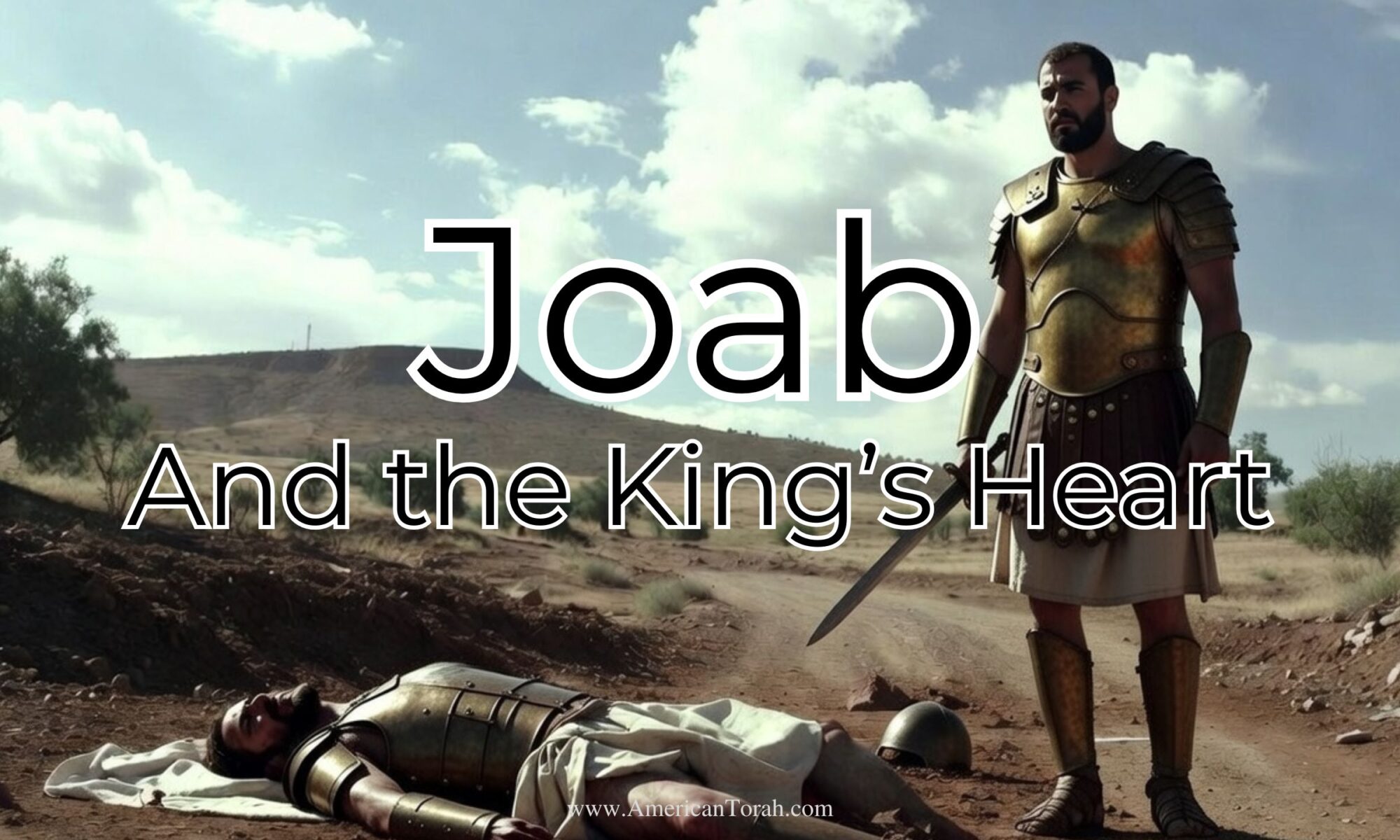
Joab and the King’s Heart

Joab seemed a faithful servant of the king, but he never really understood the king's heart.

Joab stands out in Scripture as a man among men. He was King David’s nephew and one of his inner circle when David was little more than an outlaw hiding in the caves of Judea. Joab stuck with David through the years of running from Saul, triumph after Saul’s death, and even when the rest of the Kingdom turned away. He was a fierce warrior and one of the greatest generals of ancient Israel. Even when David demoted him, his loyalty never wavered.

Yet David’s death bed instruction to Solomon was “do not let his gray head go down to Sheol in peace.” (1 Kings 2:6) In other words, “Kill him.”
How does a man who fought so loyally for David all his life end up on the king’s short list of unfinished business?

The Loyal General

Joab was the son of David’s sister Zeruiah. Blood ties run deep, but Joab’s promotion didn’t come through nepotism. He earned his place with decisive action at the battle for Jerusalem (1 Chronicles 11:6) and continued to prove his worth on battle after battle.

Consider these highlights of his military career:

  • He crushed the rebellion of Ish-bosheth, Saul’s surviving son who had claimed the throne over the northern tribes, securing David’s rule over all Israel.
  • He led campaigns against the Philistines, Ammonites, Edomites, and Syrians, expanding David’s kingdom almost to the full extent of God’s promises to the patriarchs
  • When Absalom rebelled and drove David from Jerusalem, Joab stayed with his king, commanded the loyal forces, and delivered the decisive blow that ended the uprising.

Yet there are hints of a serious problem even in the midst of these great victories.

When David heard the news of Absalom’s death, his sorrow was so great that the victorious army crept back into the city as if they had fled the battle like cowards. Joab took David’s reaction as a betrayal of those who had risked and even given their lives for the kingdom, and who could blame him? He marched into the palace and rebuked the king in front of everyone: “Today, you shamed all of your servants and your household because you love those who hate you and hate those who love you!” (2 Samuel 19:1-7)

Joab warned David that he needed to change his tune and congratulate the troops or he would face a worse rebellion than the last. David heeded Joab’s advice, but he also took the opportunity to extend an olive branch to some of the ringleaders of the rebellion, including inviting Absalom’s defeated general Amasa to replace Joab at the head of the king’s army. Joab must have felt this to be almost as great a betrayal as David’s apparent lack of sympathy for the men of his army.

When Sheba, a Benjaminite, led another rebellion in 2 Samuel 20, David’s new general Amasa proved himself to be either incompetent or treasonous; it’s difficult to tell which. He delayed assembling the army and then dragged his feet in putting down the rebellion. Joab saw what was happening and assassinated Amasa without consulting David, took command of the army, and promptly put down Sheba’s rebellion, this time with an admirable lack of bloodshed.

Joab returned to Jerusalem and probably could have taken the throne for himself if he wanted, but he didn’t have those kinds of ambitions. Joab just wanted to serve his king in the way he thought best.

This created a very awkward situation for David. It seems to me that the best course would have been some kind of severe disciplinary action, followed by a restoration to service at a lower rank, maybe as the commander of a frontier outpost or of an expeditionary force. David didn’t consult me, however. He accepted Joab back in his old place as top general, apparently without confrontation or objection.

Joab was loyal and certainly a fearless and competent soldier on the surface, but something was terribly wrong in the man and in his relationship with his king.

Joab’s Failures

A closer look at Joab’s achievements tarnishes a bit of his shine.

  • Murder of Abner – During the transition from Saul’s house, Abner came to David in peace to surrender the northern tribes. Joab, angry that Abner had killed his brother Asahel at the battle of Gibeon (2 Samuel 2:12-32), lured Abner outside the city gate and stabbed him to death (2 Samuel 3:27). David publicly mourned and cursed Joab’s house for the treachery (v. 29–39), but he didn’t punish him directly.
  • Killing of Absalom – David gave explicit orders to capture his son Absalom, but to spare his life (2 Samuel 18:5). Joab ignored the command, drove three(!) javelins into Absalom’s heart while he was stuck in a tree, let his personal armor-bearers maul him, and then threw his body in a pit.
  • Rebuke of David – He rebuked the king publicly for mourning the death of Absalom. This could have been done privately.
  • Assassination of Amasa – Joab killed Amasa in cold blood. There was need for quick, decisive action, but he doesn’t appear to have alerted David to the problem nor to what he intended to do. He certainly disregarded David’s clear instructions
  • Uriah and Bathsheba – When David ordered Joab to put Uriah in the front line and withdraw so he would be killed, Joab carried out the order without overt protest, but sent word back to David in a way that subtly but publicly shamed him for causing the deaths of numerous soldiers besides Uriah for his own selfish gain (2 Samuel 11:14–27).
  • The census – When David ordered a census of Israel’s fighting strength, Joab immediately saw the sin and protested: “Why does my lord the king desire this thing? Why should he bring guilt on Israel?” He knew that such a census was contrary to God’s instructions and could cause Israel great harm, but he carried it out anyway (1 Chronicles 21:1-7).
  • Adonijah’s Rebellion – Finally, at the end of David’s life, when his son Adonijah tried to seize the throne when everyone knew that David had chosen Solomon as his heir, Joab put his substantial support behind the usurper. The man who had spent decades protecting David’s crown now backed the wrong son.

David’s Tolerance

Why did David tolerate Joab’s disrespect for so long? The man was undeniably effective. He won battles David couldn’t afford to lose. He kept the army together when everything else fell apart. Although it seems that Joab’s loyalty was more to the kingdom itself than to David, that loyalty and his military competence bought him decades of grace from the king.

But David’s tolerance wasn’t mere pragmatism. It was prophetic. Consider Yeshua’s kingdom parables.

The Parables of the Compromised Kingdom

The Kingdom of Heaven is like a field sown with wheat and tares. An enemy sowed tare seeds among the wheat, and the two grow together until they have both grown to maturity and can more easily be separated without damaging the wheat. (Matthew 13:24–30)

The Kingdom is also like a mustard seed that grows into a small tree that is invaded by birds. (Matthew 13:31-32)

The Kingdom is also like a prince’s wedding feast. When the nobility declined the king’s invitation, he invited the commoners. When the event was well underway, the king saw one man without the appropriate attire. Since the king would have provided such clothing to any guest who could not afford it, this man had either infiltrated the wedding without the king’s invitation or he had deliberately eschewed proper respect for his host. (Matthew 22:1-14)

These three parables paint a picture of a Kingdom of Heaven in which the truly righteous (wheat, mustard tree, and respectful guests) mingle inseparably with those who only appear righteous (tares, birds, and disrespectful guest) until a time of separation and judgment. The difference between the righteous and the wicked isn’t always in their location or their deeds, but in the heart. Eventually, the state of a person’s heart always comes out in deeds, but it often takes time, and sometimes only God (the King) can tell the difference.

The King allows the tares or the birds to remain while they serve a useful purpose or while their removal might be harmful to the righteous, but their removal is guaranteed because they neither understand nor align with the heart of the King.

Joab’s Judgment

Joab was loyal and competent, but he never truly understood David’s heart.

He killed when the king said to spare. He resented the king mourning for his own son. He failed to hold the king to his own standards of righteousness. He supported a usurper over the king’s choice of heir.

Joab was like Judas–a close friend, ally, treasurer, and even a miracle-worker in the name of Yeshua–yet ultimately a betrayer. I don’t think Judas acted out of malice. He acted to force Yeshua into the role that he wanted, rather than letting Yeshua set the Kingdom’s agenda and strategy. He never really knew his master’s heart, and ended up serving that heart’s purposes anyway to his own destruction.

David’s final charge to Solomon mirrors the final judgment coming to everyone who claims to be God’s people but never truly submits. Despite all of their apparent victories and years of service, when they stand before the Bema Seat after the resurrection, Yeshua will say, “I never knew you. Depart from me, you who practice lawlessness.” (Matthew 7:23)

Joab is like religious Jews who keep a form of the Law but reject Yeshua as Messiah and like devout Christians who proclaim faith in him but refuse to obey his instructions. They do many great works, they look the part, but their heart is far from him. (Matthew 15:8) We can be the most useful soldiers in the kingdom–leading Bible studies, feeding the poor, defending sound doctrine–and still be strangers to the King’s heart.

Here’s the question you need to ask yourself: Are you Joab? Are you dutiful, victorious, and useful on the outside, but inwardly estranged from what moves Yeshua most: mercy, humility, obedience from love rather than pragmatism?

There’s still time to repent and begin the process of remaking your heart in his image. YHWH is gracious to those who seek His face in truth. The first step is to humble yourself and admit, “I don’t know what’s best. May your will be done through me, Lord, and not mine.”

Asenath and the Bride of Christ

Miketz - Asenath as a prophetic picture of the Bride of Christ.

After Joseph interpreted Pharaoh’s dreams in Genesis 41 and he was given authority over all of Egypt, Pharaoh also gave him a wife: Asenath, the daughter of a pagan Egyptian priest. I like to think that Asenath abandoned her father’s religion in favor of Joseph’s, but Scripture doesn’t tell us, and extra-biblical traditions can’t be trusted. Asenath’s relationship with YHWH is ambiguous.

The principle behind Deuteronomy 7:1-6 forbids marriage to pagans as Paul taught in 1 Corinthians 7 and 2 Corinthians 6. Yet when Jacob discovers this later, he offers no rebuke, neither does Moses nor God anywhere in Scripture. In fact, Joseph’s sons by Asenath were embraced by Jacob and adopted as heirs as if they were his own sons.

One could say that Joseph should have refused marriage to Asenath on the basis that it violated the laws of God, but there were at least two factors that could have prevented him from doing so:

  • First, he knew at this point that his mission was to save Egypt. If he refused Pharaoh’s orders, would he have jeopardized his ability to carry that out?
  • Second, it’s important to remember that Joseph, despite being made prime minister of the most powerful nation on earth at the time, remained a slave. He might not have believed he had the power to refuse.

There is perhaps another factor.

Egypt is a prophetic stand-in for the whole world. Joseph was a prophet and might have been aware that his entire life–his dreams, coat, betrayal, burial, “resurrection”, and ascent to the throne–was prophetic of a future Messiah who would save his people from a spiritual famine and make that salvation available to the whole world.

Contrary to much Christian teaching today, the Bride of Christ is not a new thing created in Acts 2, but the continuation of something that God promised to Abraham and created at the time of the Exodus from Egypt. Israel, including the natural descendants of Abraham according to the promise through Isaac as well as those from among the nations who join Israel and obey Israel’s God, is and has always been the Bride of Christ.

In the time of Yeshua’s first incarnation, the natural descendants of Jacob were scattered across the known world, many of them completely unaware of their genetic heritage, not unlike today. Even those who called themselves Jews and lived in Judea were following a man-made religion more than they were following the commandments of YHWH. Those Gentiles who put their faith in Israel’s Messiah and repented from their paganism also become members of the Body of Christ.

Together, the Jews who returned to God’s instructions and the Gentile believers who rejected the pagan lies of their forefathers, are like Asenath, the daughter of a pagan priest married to the Savior of Israel. Asenath was a living prophecy of the faithful remnant of Israel and the adoption of a mixed multitude from among the nations.

The Gospel, the Garden, and the Golden Calf

Thematic connections between the Fall in the Garden of Eden, the Golden Calf at Mount Sinai, and the Gospel.

My wife, Paula, is reading through Exodus, and last week she noticed several parallels between the stories of the Garden of Eden (Genesis 3) and the Golden Calf (Exodus 32). As we talked about them, those parallels deepened and it soon became apparent that both stories had Yeshua stamped all over them. I’m sure that some of those parallels will seem obvious–temptation, disobedience, passing the buck–but others are more subtle and significant.

Helping God in His Absence?

In the Garden, Eve was tempted by the serpent in the apparent absence of God and then she tempted Adam. At Sinai, the people began to doubt when it seemed like Moses wasn’t coming back. They likely felt confused and vulnerable, perhaps even abandoned. Genesis doesn’t seem to indicate the same about Eve, but her response was similar. In both cases, the people decided not to wait for God and to take matters into their own hands. They both tried to bridge a perceived gap that God had not authorized them to bridge.

In the Garden, the serpent told Eve that she could make herself like God. If mankind was created in God’s image, telling Eve that she would be like God, knowing Good from Evil, could have been intended to make her think that this is really what God wanted for them from the beginning. They could more fully accomplish their role on earth by being more like God himself.

At Sinai, he told the people that they could make themselves an inanimate mediator to represent YHWH in the camp. Since God had provided a mediator in the person of Moses and they had been unable to receive God’s Law directly from the source, they probably thought it was reasonable to make a replacement.

They weren’t trying to replace God himself; they were just trying to help him to help them.

The Surrender of Authority

People in the Bible often wore rings as symbols of authority. A ring in the ear or nose indicated submission, while a ring on the finger indicated the bearing of authority. Recall the pierced ear of the bond servant in Exodus 21:2-6 and the signet rings of Judah and Joseph in Genesis 38:18 and Genesis 41:42.

When the people demanded that Aaron make them a replacement for Moses, he told them to take the gold rings from the ears of their wives and children to make an idol, rings that symbolized their families’ submission to their authority. I believe that Aaron told them to bring these specific items and not their signets, arm bands, and other gold objects later given for the furnishings of the Tabernacle, in order to say, “You want me to disrupt your relationship with God, so I will disrupt your relationship with your families.”

Likewise, in the Garden, humanity probably would not have been expelled if Adam had not surrendered his authority over Eve to the serpent by not protecting her and instead joining her in eating of the forbidden fruit. In both stories, the people rebelled and their spiritual coverings aided and joined them.

Mankind might not have needed a savior and Israel might not have needed an earthly High Priest and priestly caste if they had not surrendered their authority to a false god.

Hiding from God

When God came to visit Adam and Eve in the Garden, they tried to hide themselves because of their shame. When he confronted them, Adam tried to blame Eve, and Eve tried to blame the serpent.

When Moses returned from Mount Sinai, the people couldn’t hide. God told him, “I have seen this people,” (Exodus 32:9) and Moses could hear the sound of their partying from all the way up the mountain. However, Aaron did try to shift the blame. First he blamed the people. “You know how these people are determined to do evil,” he told Moses in verse 22. Then he blamed the fire and gold in verse 24: “I threw it into the fire and out came this calf!”

Of course, nobody can really hide from God, and nobody can escape the consequences of their actions. It seems at first that Aaron got away without punishment for his role in the golden calf incident, but that’s not really true.

Cascading Consequences

God told Adam, “In the day that you eat of the fruit of the Tree of Knowledge of Good and Evil, you will surely die” (Genesis 2:17) and he told Moses, “Whoever has sinned against me, I will blot out of my book…In the day when I visit, I will visit their sin upon them” (Exodus 32:33-34). These statements continue to puzzle theologians today because these threats don’t appear to have been literally carried out. Adam lived more than 900 years and Aaron lived almost 40 years after their respective sins.

God did punish the people at the time of their sin. Adam and Eve were expelled from the Garden by an angel bearing a flaming sword and the Israelites at the center of the calf worship were killed by sword-bearing Levites. God condemned Adam and Eve to a life of struggle and eventual death and he sent a plague among the Israelites, but neither of these really fulfill the letter of his promise.

There are several concepts that aren’t immediately apparent in the plain text and will have to wait for another article. I’m going to focus on one of those ideas for now: A dramatic change in role is analogous to death and resurrection.

As the first man, all of humanity is blessed and cursed through Adam. He wasn’t only expelled from the garden and condemned to die himself, but every person since is also condemned to die because of what he did. On the day that Adam ate the fruit, his role in the world changed from God’s governor to a mediator of death to all humanity.

When Aaron took the authority of all the men of Israel in order to create a thing that could never act as a true mediator, he condemned himself to occupying that role. This was a mixed curse, of course. It’s a great blessing to serve God by leading his people in worship, but Aaron also died to his prior role as Moses’ prophet, giving up any chance of an ordinary life, and was metaphorically resurrected as a mediator for the whole nation.

An Insufficient Mediator

Unfortunately, neither Adam nor Aaron were capable of finally undoing the damage they had done. They had both created their roles by sinning, by becoming imperfect, and that which is imperfect can never make itself perfect again. Adam and Aaron both presided over what Paul called a “ministry of death”. They could never do anything more than guide their people until inevitable death.

Ultimate restoration required a different kind of mediator, one without sin, who had never caused the people to stumble nor participated in their rebellion. The stories of the sin in the Garden and the sin of the Golden Calf are purposely told in such a way to highlight these parallels in order to illustrate mankind’s need for a perfect mediator and redeemer in the person of Yeshua.

He filled the role of God and Moses by coming down from Heaven to observe and confront the sin of mankind.

He filled the role of Eve and the Hebrews by living as an ordinary human subject to trials, temptations, joys, and sorrows.

He filled the role of Adam and Aaron by taking authority over mankind and the responsibility of their sins onto his shoulders through the cross. Like them, he died to one life and resurrected to another, but the great and essential difference is that his death was undeserved and his resurrection complete. Adam and Aaron deserved their punishments, while Yeshua did not, and so he will remain forever a perfect High Priest and Kinsman Redeemer.

Torah vs Yeshua?

Luke wrote:
Luk 16:29-31 Abraham saith unto him, They have Moses and the prophets; let them hear them. And he said, Nay, father Abraham: but if one went unto them from the dead, they will repent. And he said unto him, If they hear not Moses and the prophets, neither will they be persuaded, though one rose from the dead.

Although that conversation was ostensibly about being generous and kind, it was also a roundabout reference to eternal salvation and the resurrection of the Messiah. Through this parable, Yeshua was hinting that those who reject the testimony of Moses will also reject the Messiah and his testimony.

John wrote:
Joh 5:42-47 But I know you, that ye have not the love of God in you. I am come in my Father’s name, and ye receive me not: if another shall come in his own name, him ye will receive. How can ye believe, which receive honour one of another, and seek not the honour that cometh from God only? Do not think that I will accuse you to the Father: there is one that accuseth you, even Moses, in whom ye trust. For had ye believed Moses, ye would have believed me: for he wrote of me. But if ye believe not his writings, how shall ye believe my words?

Yeshua was accusing the Jewish elite of not having the love of God, and he referred them to the writings of Moses (the Torah) as evidence. They were trusting in the Torah for their salvation, but they never obeyed (John 7:19) or even believed what was in it. The spirit of the Law is love of God and mankind, and its primary aim is the redemption of mankind by the Messiah as the ultimate embodiment of that love. Therefore, if your life is in line with the Torah, then you are aiming at the Messiah. The converse is also true. If your life is not in line with the Torah, then you are not aiming at the Messiah.

Paul, or someone very like him, wrote:
Heb 10:28-29 He that despised [does away with, sets aside, disregards, nullifies, rejects, refuses -Thayer’s Greek Definitions] Moses’ law died without mercy under two or three witnesses: Of how much sorer punishment, suppose ye, shall he be thought worthy, who hath trodden under foot the Son of God, and hath counted the blood of the covenant, wherewith he was sanctified, an unholy thing, and hath done despite unto the Spirit of grace?

In other words, if anyone who rejects the Torah deserves to die without mercy, how much more does anyone who rejects the sacrifice of Yeshua deserve to die? This is a light and heavy argument which requires that the first premise be true before the second can be true. If rejection of the Torah does not call for death, then the second premise is meaningless. Zero multiplied by anything is still zero.

I’m not saying you have to obey–or even try to obey–the Torah to be saved. I’m saying that it’s very difficult to hit a target if you don’t know what it looks like. I’m also saying that if you really are aiming at the right target, Yeshua, then you are already obeying Torah, and your life will show it.